

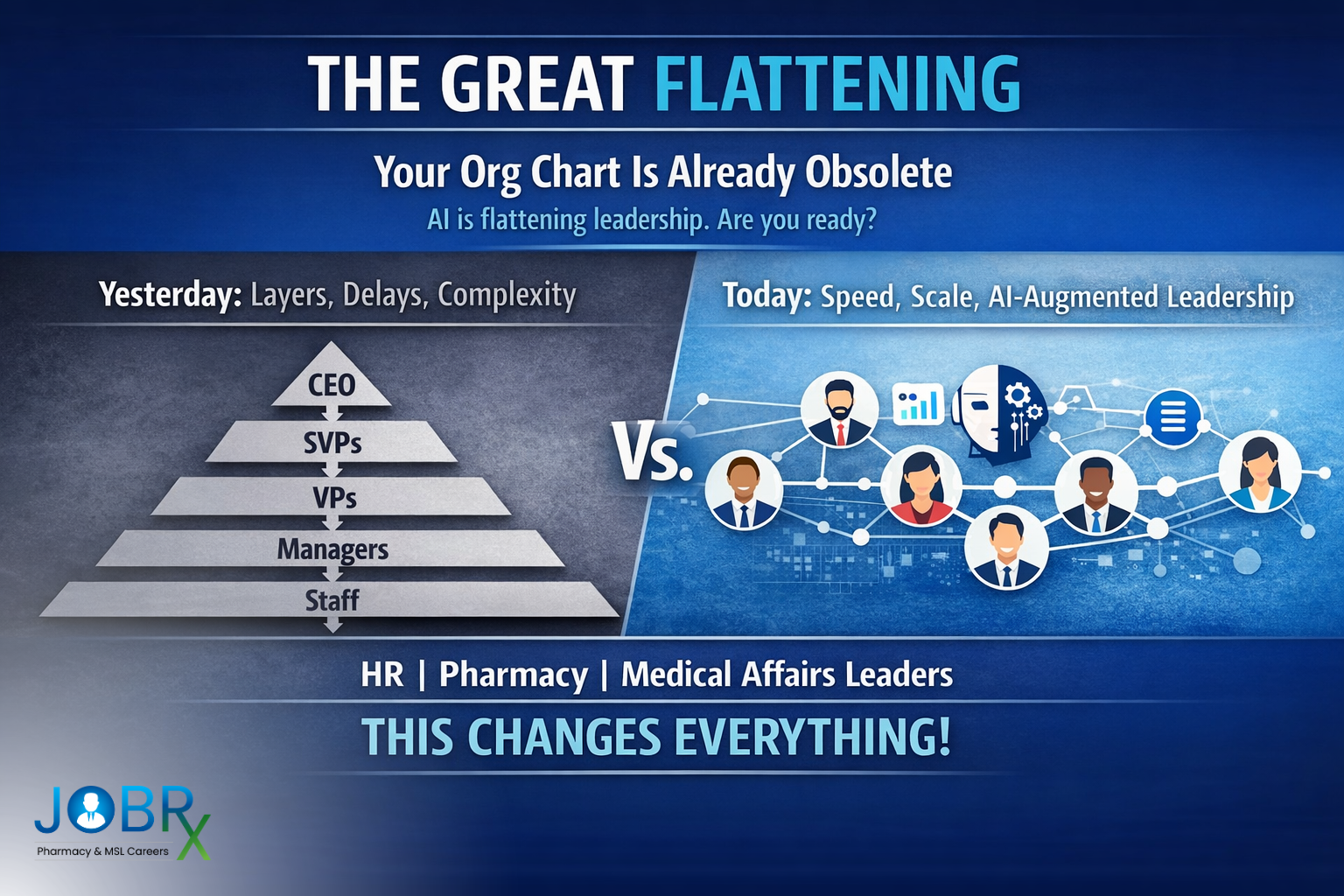
Your Org Chart Is Already Obsolete — AI Just Hasn’t Told You Yet
The Great Flattening: How AI Is Reshaping Leadership in HR and Life Sciences
What if your org chart is already obsolete — and you just haven’t redrawn it yet?
AI isn’t just changing how work gets done. It’s quietly dismantling one of the most entrenched structures in business: the management hierarchy.
For HR leaders, Pharmacy Directors, and Medical Affairs executives, this isn’t a future scenario — it’s happening now. And the implications for leadership, hiring, and organizational design are massive.
From Hierarchies to Horizontal Speed
For decades, organizations added layers of management to drive oversight and control. But those layers have come at a cost: slower decisions, higher overhead, and diluted accountability.
Now AI is changing that equation.
- Nearly 88% of organizations are already using AI in at least one business function
- 75% of knowledge workers are using AI tools regularly
- Managers now supervise nearly twice as many employees as they did in 2019
AI is enabling leaders to oversee broader scopes, automate coordination, and accelerate decision-making — without the need for additional layers.
This is what many are calling “The Great Flattening.”
Why This Matters for HR Leaders
For HR Directors, this is not simply an org design conversation — it’s a workforce transformation imperative.
- 67% of HR leaders say AI is already significantly impacting jobs
- 20% of organizations are expected to use AI to flatten structures
- Yet, 95% still plan to retain human workers alongside AI
This creates a new challenge:
 Do more with fewer layers — without losing effectiveness.
1. Leadership Is Being Redefined
AI is shifting leadership from supervision to orchestration.
- Up to 25% of tasks may be fully automated
- 75% of work will be AI-augmented
Leaders must now manage:
- People
- Systems
- AI-driven workflows
2. Workforce Planning Is Being Rewritten
Organizations are moving away from rigid hierarchies toward fluid, capability-based models.
- Access to AI tools grew 50% in just one year
- Only 34% of companies are fully redesigning around AI
HR leaders must rethink:
- Role design
- Talent mobility
- Leadership pipelines
3. Reskilling Is Now a Business Priority
- AI skills gaps remain the #1 barrier to transformation
- 55% of leaders say removing workers after AI adoption was a mistake
The takeaway:
AI doesn’t reduce the need for talent — it raises the bar for it.
The Life Sciences Perspective: Speed Meets Complexity
In life sciences and pharma, the stakes are even higher.
AI is accelerating:
- Clinical insights
- Regulatory strategy
- Medical affairs intelligence
- 64% of organizations say AI is driving innovation
- 50% of high-performing companies are redesigning workflows around AI
For Pharmacy Directors and Medical Affairs leaders:
You must move faster — without compromising compliance.
Flattened structures enable:
- Faster safety signal escalation
- Real-time cross-functional collaboration
- More agile decision-making
But they also demand:
- Stronger governance
- Clear accountability
- Leaders comfortable operating with less hierarchy
What This Means for Hiring and Talent Strategy
This is where strategy becomes action.
As organizations flatten, the profile of leadership talent is changing rapidly.
Today’s most in-demand leaders can:
 Lead without layers
Operate effectively in low-hierarchy environments
Leverage AI in decision-making
Not technical experts — but AI-enabled leaders
Orchestrate across functions
Especially in complex pharma ecosystems
Balance speed with compliance
Critical in regulated environments
Emerging Roles to Watch
We’re already seeing increased demand for:
- Director of AI-Enabled HR Transformation
- Head of Medical Affairs Operations & Insights
- Pharmacy Innovation & Digital Strategy Leaders
- Enterprise AI Program Leaders
These roles reflect a broader shift:
From managing people… to orchestrating systems, talent, and intelligence
A Shift in Power — and Responsibility
Flattening doesn’t just remove layers — it redistributes accountability.
Leaders closer to the front lines now have:
- Greater autonomy
- Faster decision cycles
- Increased visibility
But this isn’t about eliminating management altogether.
It’s about removing friction, not removing leadership.
Key Questions for Leaders Right Now
- Is our structure enabling speed — or slowing us down?
- Are we hiring for yesterday’s roles — or tomorrow’s capabilities?
- Do our leaders know how to manage AI alongside people?
- Where can we flatten responsibly without increasing risk?
Final Thought: This Is Not Optional
The “Great Flattening” is already underway.
Organizations that embrace it will gain:
- Speed
- Efficiency
- Competitive advantage
Those that don’t risk becoming:
- Slower
- More complex
- Less attractive to top talent
The opportunity isn’t just to adopt AI — it’s to redesign leadership around it.
 Let’s Open the Conversation
How is your organization thinking about flattening structures in the age of AI?
- Are you actively reducing layers?
- Redefining leadership roles?
- Hiring differently at the Director level?
I’d be especially interested to hear from:
HR leaders navigating workforce transformation
Pharmacy and Medical Affairs leaders balancing speed with compliance
What’s changing in your organization — and what’s proving hardest to rethink?