

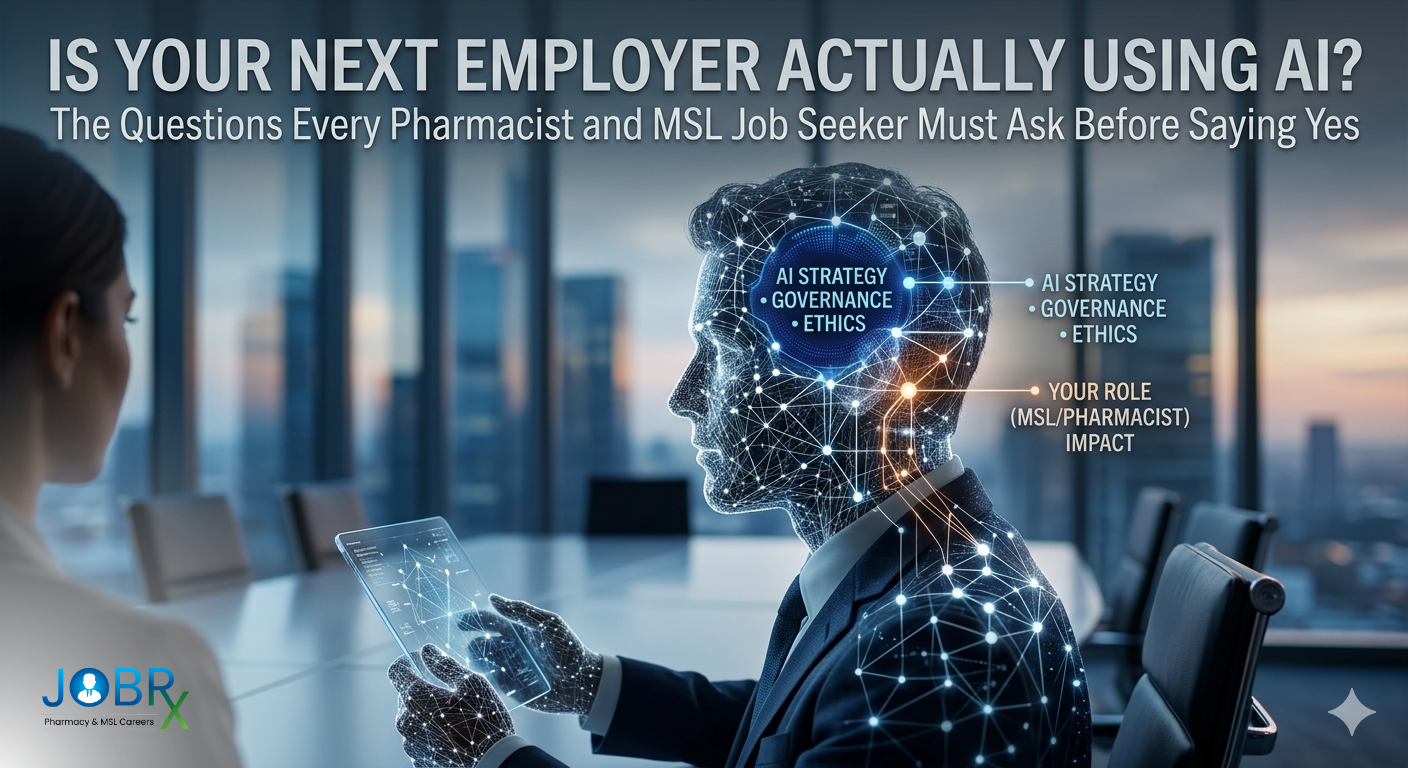
Is Your Employer Actually Using AI?
Is Your Next Employer Actually Using AI? The Questions Every Pharmacist and MSL Job Seeker Must Ask Before Saying Yes
You spent days/weeks preparing for your next interview. You polished your resume, practiced your STAR stories, and researched the pipeline.
But here is the question most healthcare professionals never think to ask their prospective employer: “What is your actual AI strategy, and how does it affect my role?”
In 2026, that question is no longer optional. It is one of the most revealing things you can bring into any pharmacy or medical affairs interview.
AI is no longer a future-state conversation in pharmacy and pharma. It is happening right now, across health systems, specialty pharmacies, and medical affairs teams.
ASHP formally recognizes that AI has the potential to improve patient care and the medication-use process by offering innovative methods to gather clinical, operational, and economic knowledge, streamline administrative processes, and assist end users across pharmacy practice.
The numbers behind this shift are striking. According to a recent survey, 45% of pharmacy employers have already integrated AI systems into their workflows, reshaping job requirements in the process.
For MSLs, the evolution is equally significant. Machine learning tools are now used in drug discovery, predicting patient adherence, optimizing digital advertising, and even tailoring outreach to healthcare professionals, all functions that intersect directly with medical affairs strategy.
The challenge is that not all employers are at the same stage of this journey. Some are genuinely AI-integrated. Others are AI-adjacent at best. And some are simply AI-talking.
Knowing the difference before you sign an offer letter could define the trajectory of your next three to five years.
Core Insights
1. Ask About Their AI Strategy, Not Just Their Tools
The first thing you want to understand is whether a company has a coherent AI vision or is simply reacting to industry buzz.
Ask directly: “What is your AI strategy for 2026 and beyond, and how does it connect to how my team operates day-to-day?” A vague or deflective answer tells you something important, it signals that leadership has not yet made AI a real organizational priority.
The ASHP 2025 Pharmacy Forecast recommends that organizations drive a unified approach to AI that elevates the role of pharmacists and establishes proper institutional governance to manage it.
If the employer you are interviewing with has not done that work yet, you want to know upfront so you can factor it into your decision.
2. Find Out Which Tools You Will Actually Have Access To
A meaningful difference exists between a health system that has invested in enterprise-grade AI platforms and one that expects you to use a free chatbot on your personal device.
Ask specifically: “Will I have access to paid AI tools as part of my role, and which ones are approved for clinical or scientific use?”
Commonly used platforms in pharmacy and healthcare settings include ChatGPT, Perplexity AI, Claude, and Copilot, with paid upgraded versions demonstrating improved factual accuracy, citation reliability, and readability compared to free tiers.
For MSLs, where scientific accuracy is non-negotiable, the quality of the tools your employer provides matters enormously. Companies that invest in the right infrastructure are investing in you.
3. Understand Whether AI Use Is Monitored, Restricted, or Encouraged
This is one of the most overlooked questions in any interview, and it reveals a great deal about a company’s internal culture.
Ask: “Is there guidance around how AI tools should be used in this role, and are there restrictions I should be aware of?” Some organizations have robust AI governance frameworks. Others have none at all.
Among 2023 ASHP Pharmacy Forecast panelists, 73% predicted that health systems will be required to validate the safety and effectiveness of AI tools, while only 37% reported being prepared to perform that validation.
That gap represents both a risk and an opportunity and you want to know which side of it your potential employer sits on.
4. Clarify What They Expect YOU to Build
AI integration does not happen automatically. Someone has to lead it. In many organizations right now, that someone ends up being the newest hire with the most enthusiasm.
Ask: “Is there an expectation that I will help develop or adapt AI workflows within this role?” This question protects you from walking into a position where significant uncompensated work around AI implementation is hidden inside a traditional job description.
ASHP’s case study library highlights real-world examples of pharmacists who implemented AI-assisted tools that led to measurable improvements in provider burnout, appointment capacity, and documentation quality but those outcomes required dedicated time, leadership support, and clear institutional backing.
Pro Tip: Don’t go into your interview empty-handed. I’ve mapped out these questions and the strategy behind them in this Visual Interview Guide. Open it on your tablet or print it as a reference: Explore the Interactive Map Here
Career and Opportunity Angle
For MSL job seekers, AI fluency is quickly becoming a differentiator in a crowded field. While AI can write copy or sort data, it cannot strategize, empathize, or innovate like a skilled professional. Understanding therapeutic nuances or interpreting brand sentiment across multiple channels still requires human judgment.
That is your competitive edge. But it only holds if you are working for an organization that understands where AI ends and where you begin.
Pharmacists navigating leadership transitions and pharmacy technicians seeking advancement face a similar reality. Industry forecasts suggest a 40% increase in demand for AI-related skills in healthcare over the next five years. Meaning the professionals who can work alongside AI tools, not just use them passively, will lead the next generation of pharmacy and medical affairs practice
Call to Action / Closing
Your next interview is not just about proving your value to a potential employer. It is also about evaluating whether they are the right environment for your growth.
The questions you ask about AI will signal your strategic thinking, your adaptability, and your understanding of where healthcare is heading. Come prepared with specific ideas about how you would use AI in the role. Ask with curiosity, not skepticism.
And listen carefully for answers that are vague, dismissive, or rehearsed. The organization that welcomes those questions is probably one worth joining.