

Why Your Best Hires Still Fail as Leaders
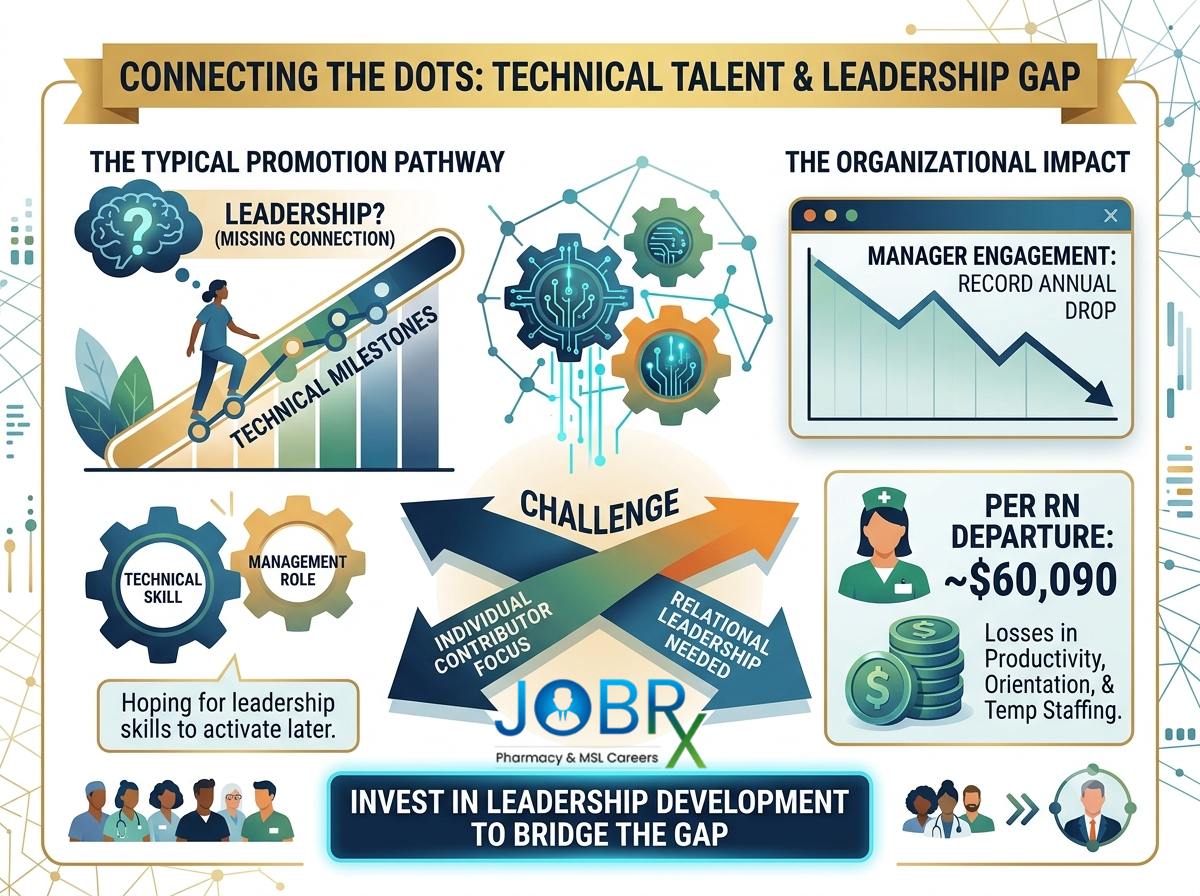
Manager engagement just recorded its steepest one year drop in Gallup’s history, falling from 27 percent to 22 percent between 2024 and 2025.
Meanwhile hospitals are absorbing a national RN turnover rate of 17.6 percent, at a cost of roughly $60,090 per departure. Your best clinician is not the problem. Your promotion criteria might be.
Healthcare and HR leaders keep promoting top performers into leadership roles based on clinical skill or tenure, then wonder why the team underperforms within a year. Gallup research shows managers now account for 70 percent of the variance in team engagement.
When that lever breaks, everything downstream breaks with it: retention, patient outcomes, and recruiting cost.
For Talent Acquisition and HR Directors, this is not a training gap. It is a selection gap. Only 44 percent of managers worldwide have ever received formal management training. Organizations keep filling leadership pipelines with people who were never screened for the behaviors leadership actually requires.
Fixing that starts at the interview and succession planning stage, not after the promotion.
1. Clinical or technical excellence does not predict leadership success. The skills that make someone a strong nurse, pharmacist, or analyst rarely overlap with the skills that make them a strong people leader. Coaching, delegation, and conflict management are separate competencies.
Screening for them before promotion, rather than hoping they emerge, is the single highest leverage change most healthcare HR teams can make.
2. Empathy is measurable, and it predicts performance. A widely cited assessment of more than 15,000 leaders across 20 industries found empathy, particularly the ability to listen and respond well, was the strongest predictor of overall leadership performance. Structured behavioral interviews can surface this trait directly.
Ask candidates to describe a specific time they adjusted their approach because of what an employee was going through, and score the answer for specificity, not sentiment.
3. Manager burnout is now a retention risk in its own right. Nearly half of employees who voluntarily leave a role report that no manager or leader discussed their job satisfaction or career path in the three months before they resigned.
In hospital settings, where RN turnover already costs an average hospital between $3.9 million and $5.7 million a year, undertrained or disengaged managers compound an existing crisis rather than solving it.
4. Transparency reduces the uncertainty that drives attrition. Gallup attributes 69 percent of voluntary departures to culture and wellbeing factors rather than pay. Candidates for leadership roles who default to withholding information under pressure, rather than sharing context, are a flight risk for the teams they will eventually manage. Build a transparency scenario into your leadership interview loop and listen for how candidates handle it.
For Talent Acquisition teams, this is a chance to redesign the leadership pipeline rather than patch it after the fact. Build empathy, transparency, and coaching orientation into your competency model for every internal promotion and external leadership hire.
For HR Directors, this reframes leadership development spend: a screening process that catches poor fits before promotion is cheaper than a training program that tries to fix them after.
In a labor market where one percentage point of RN turnover costs the average hospital $289,000 a year, the ROI case for better leadership selection writes itself.
Before your next leadership promotion or hire, pull the job description and ask whether it actually screens for empathy, transparency, and coaching skill, or whether it still rewards tenure and technical output by default.
Small changes to your interview rubric now will show up in your retention numbers within two quarters. Share this with a colleague who owns leadership hiring decisions, and let’s keep raising the bar on what “leadership ready” really means.