

The Leadership Skills Pharmacy and Medical Affairs Directors Need as 2027 Approaches.
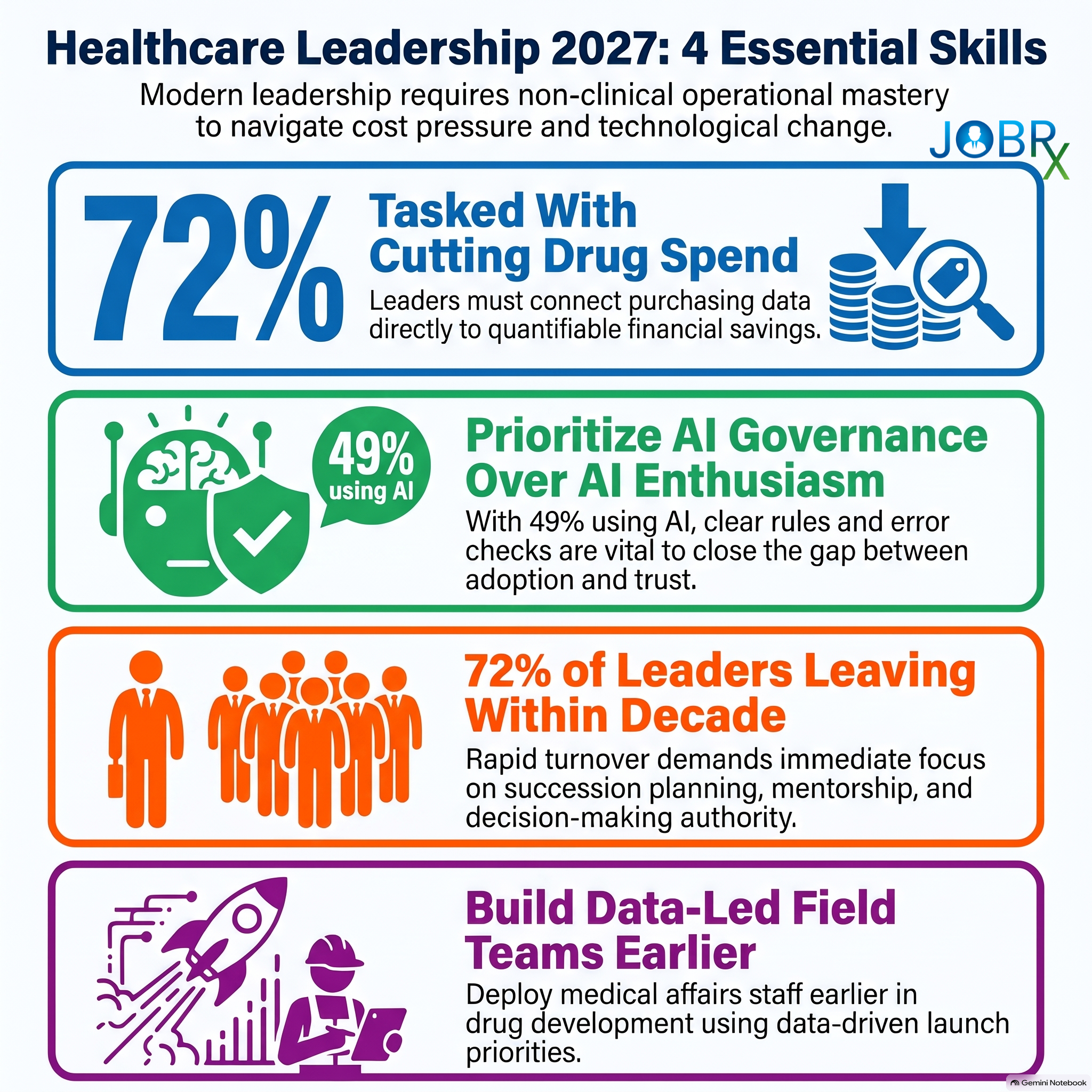
72% of hospital pharmacies were tasked with cutting drug spend in 2026. 49% of surveyed hospital pharmacy professionals already use AI tools at work. Neither number appears on a clinical résumé.
For Pharmacy Directors, Medical Affairs Directors, and the HR leaders who hire them, the 2026 data points to a leadership job that looks different from the one clinical training prepares people for.
Hospital pharmacy leaders carry budget, supply chain, technology, and people responsibilities at the same time. Medical Affairs leaders are building field teams in a market that is changing quickly.
This newsletter reads five recent sources together and draws four leadership skills from them. The sources report pressures and attitudes. The skills are our analysis of what those pressures imply.
A strong clinical record opens the door, but it does not show how a candidate will lead through cost pressure, new technology, and a stretched team.
The Bluesight 2026 Hospital Pharmacy Operations Report surveyed 437 hospital pharmacy professionals in January and February. About 78% cited drug shortages as a top issue, the seventh year in a row. Bluesight is a technology vendor, and the sample is not a national census, so read the figures as a directional signal.
Hiring conditions are also shifting. BioSpace’s Q2 2026 job market report, as covered by Drug Discovery and Development, counted 26 biopharma companies making or planning cuts, down from 64 a year earlier. Live postings on its site rose 15%.
1. Financial and Supply Chain Fluency
In the Bluesight survey, 72% of hospital pharmacies were tasked with reducing drug spend in 2026, and 70% of pharmacy leaders prioritized streamlining purchasing.
Directors who cannot connect purchasing data to savings will struggle in this environment. Ask candidates for the dollar figure they managed and the savings they delivered. Request the baseline, the target, and the timeline so you can judge the result.
2. AI Governance, Not AI Enthusiasm
49% of Bluesight respondents use AI tools in their workflows, mostly for reporting and diversion detection. 56% believe AI should support shortage prediction, but only 9% use it that way. Respondents named accuracy concerns, privacy risks, and policy restrictions as the main barriers.
A UK survey from the Royal College of Pharmacy found that 74% of 141 responding pharmacists had concerns about AI tools. That sample was self-selected, so treat it as a signal, not a benchmark. The gap between belief and use suggests directors need clear approval rules, error checks, and staff training before they scale any tool.
3. Decision Authority and Succession
A survey of 788 health-system pharmacy leaders appeared in the June 2026 issue of the American Journal of Health-System Pharmacy. Its data came from 2024. 72% planned to stay in their current role for 10 years or less.
94% to 98% rated the ability to influence decision-making as moderately or very important. Poor upper-level management was a discouraging factor for 85% to 89% across system, hospital, and mid-level groups. The authors recommend attention to succession planning, mentorship, and work-life balance.
Ask candidates how they are developing a successor and what they changed after a manager raised a concern.
4. Building Medical Affairs Teams Early, With Data
EPM Scientific, a life sciences recruiter, reports that hiring for field medical roles is happening earlier in the drug development cycle, with companies bringing in scientific and clinical staff well before a product is approved.
EPM links this to the concentration of oncology, cell and gene, and rare disease launches in 2026, and says Medical Affairs is becoming more data-led. These are the recruiter’s own assessments, not independent survey data.
They suggest Medical Affairs Directors should be ready to show a launch readiness plan and data-driven field priorities. Ask how they chose their first hires and which data informed that choice.
Pharmacy leaders pursuing Pharmacy Jobs at the director level should quantify their record: drug spend reduced, technician vacancies filled, turnover changed.
Replace general claims about improving operations with figures a hiring committee can verify.
Medical Affairs professionals moving from Medical Science Liaison Jobs into leadership should document launch readiness work, cross-functional results, and the data they used to set priorities.
HR leaders can convert these four skills into a structured scorecard for leadership searches. BioSpace data shows hiring activity recovering, so competition for strong leaders may rise. A Personal Recruitment Services partner can help benchmark roles, but the scorecard should start with your own definition of leadership.
Which of these four skills is your biggest gap? Pick one to work on this week. Small, specific steps matter more than broad resolutions.
Directors, add one financial metric to your next performance review. HR leaders, add one structured question about AI governance or succession to your next leadership interview. Medical Affairs leaders, map your team’s launch readiness against the data you can show today.
Share your answer in the comments or reply to this email. Your experience helps the whole community lead better.