

Graduating Into an AI-First Healthcare World: What Empathetic Leadership Means for Your Career
You just crossed the stage. The degree is real, the loans are real, and so is the question nobody warned you about in school: What does it actually feel like to walk into a pharmacy or Medical Affairs team that is already mid-transformation with AI?
A February 2026 Gallup survey of more than 23,000 U.S. employees found that 27% of workers in AI-adopting organizations say their workplace has changed in disruptive ways to a large or very large extent in the past year.
You are not walking into the healthcare system your professors trained you for. You are walking into one being rebuilt in real time.
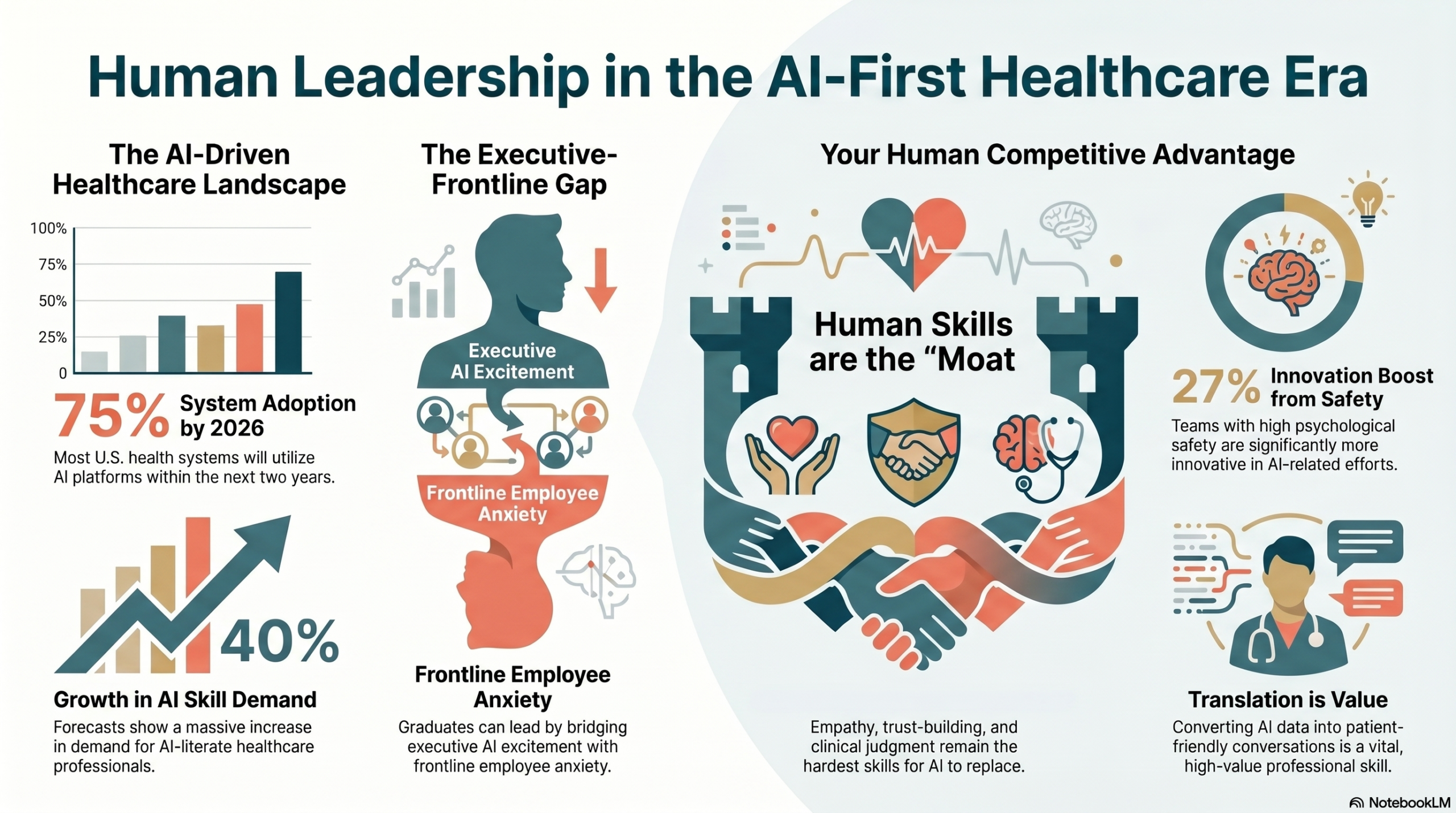
Seventy-five percent of U.S. health systems now use or plan to use an AI platform in 2026, with 50% running three or more AI applications simultaneously.
For new pharmacists and aspiring Medical Science Liaisons entering the workforce this graduation season, that number is not an abstraction.
It means your first 90 days on the job will likely include AI-assisted clinical documentation, AI-powered drug interaction screening, or AI-generated scientific summaries that you will need to critically evaluate and communicate to patients and providers.
ASHP’s 2026 Summit on Pharmacy Workforce Transformation in the Age of AI was designed specifically around the questions facing new graduates: how work is performed, how responsibilities and competencies will change, and how to prepare the workforce to adapt and lead.
For MSL job seekers, the picture is equally clear. In 2026, Medical Affairs is no longer proving its value it is scaling to meet the increasingly complex demands of modern healthcare ecosystems, with AI moving from pilot programs to an operating system that teams must be current with to remain competitive.
The anxiety new graduates feel is legitimate and documented. Research shows that 71% of U.S. workers are concerned that AI will put people permanently out of work, and 75% of employees believe AI will make certain jobs obsolete.
What separates the graduates who thrive from those who stall is not whether they feel that anxiety. It is whether they understand the human leadership dynamics that determine how AI gets adopted and how they can position themselves inside those dynamics from day one.
1. The Gap Between Executive Optimism and Frontline Anxiety Is Your Competitive Advantage
Research published in Harvard Business Review reveals a significant gap between how executives perceive AI adoption and how employees actually experience it, with most workers feeling anxious and far less enthusiastic than their leaders assume. As a new graduate, you sit at a valuable intersection.
You are tech-native enough to adapt quickly, but clinically trained enough to be credible. Pharmacy Directors and Medical Affairs leaders are actively looking for team members who can bridge that gap who are comfortable with AI tools without losing sight of patient outcomes and scientific integrity.
Recognizing this gap when you walk into your first role is a strategic advantage. You can be the person who translates AI outputs into clinically meaningful language, asks the right questions, and flags when an algorithm’s recommendation does not align with patient-specific factors.
That is not a junior skill. That is exactly what empathetic, forward-thinking healthcare teams need right now.
2. Psychological Safety Is the Real Differentiator in AI-Adopting Organizations
While 83% of executives link psychological safety to AI success, only 56% of employees feel secure enough to explore AI tools, and teams with high psychological safety report 27% more innovation in AI-related efforts.
For new pharmacists and MSL candidates, this data carries a direct career implication. The organizations worth joining are the ones building psychological safety into their AI rollout not the ones mandating tool adoption without training or support.
During interviews, ask how the team approaches AI experimentation. Ask whether there is formal training, mentorship, or space to ask questions without judgment.
ASHP has noted that there are not yet established AI-related competencies for student pharmacists, and that faculty themselves are navigating new territory which means the burden of building that safety net falls on the organizations hiring you.
If a hiring manager cannot speak to how they support that transition, that is valuable information before you sign an offer.
3. Empathetic Leadership Is a Skill You Can Demonstrate on Day One
Employees of empathic companies work harder, collaborate more efficiently, and generate stronger ideas and empathetic leadership is now directly linked to whether organizations successfully adopt AI or stall.
Most new graduates assume empathetic leadership is something they will develop over years of management experience. That assumption is worth challenging. It begins in your first peer interaction, your first handoff conversation with a physician, and your first MSL field visit.
Empathetic leaders create the psychological safety that allows people to exchange ideas, challenge norms, and take risks that drive real innovation and in 2026, innovation will not come from pressure but from leaders who create space for curiosity and experimentation.
As a pharmacist or MSL candidate, demonstrating active listening, asking thoughtful follow-up questions, and acknowledging a colleague’s concern about a new AI workflow is empathetic leadership in action. It does not require a title. It requires intention.
4. The Skills AI Cannot Replace Are the Skills That Will Define Your Career
Industry forecasts project a 40% increase in demand for AI-related skills in healthcare over the next five years, but the most durable competencies remain human-centered: compassionate care, trust-building, and the emotional intelligence that machines cannot replicate.
For MSL job seekers specifically, AI is not expected to diminish the MSL role if anything, it makes the role more sophisticated, with KOL engagement moving beyond static CRM notes toward real-time, individualized scientific relationship-building that no algorithm can substitute.
The pharmacist who can interpret an AI-flagged drug interaction and then communicate the nuance clearly to a patient is more valuable than the algorithm.
The MSL who can synthesize AI-generated literature reviews and then build a genuine scientific relationship with a Key Opinion Leader is irreplaceable. Your value is not in competing with AI. It is in doing what AI structurally cannot.
Career and Opportunity Angle
For pharmacists exploring clinical pharmacist jobs, hospital pharmacy jobs, and specialty roles, AI literacy is now a visible hiring criterion.
Pharmacy Directors want candidates who can adapt to AI-assisted dispensing and documentation workflows without abandoning clinical judgment. For those pursuing Medical Science Liaison jobs including remote MSL jobs in Medical Affairs the bar has shifted. Hiring managers want MSLs who can evaluate AI-generated scientific content critically, engage KOLs with genuine human connection, and operate with emotional intelligence in a field environment that AI will never fully navigate.
A Pharmacist Personal Recruiting Service can help you identify which organizations are building the kind of empathetic, AI-forward cultures where your human skills will be both valued and developed.
You earned this degree in one of the most consequential moments in healthcare history. AI is not the threat to your career. A lack of self-awareness about what you uniquely bring to an AI-first team is.
Lead with empathy. Ask the right questions in your interviews. Choose organizations that invest in their people as deliberately as they invest in technology. Your ability to connect, communicate, and think critically is not a soft skill. It is the skill that will define your trajectory in pharmacy and Medical Affairs for decades to come. Share this with a classmate who is figuring out their next step.