

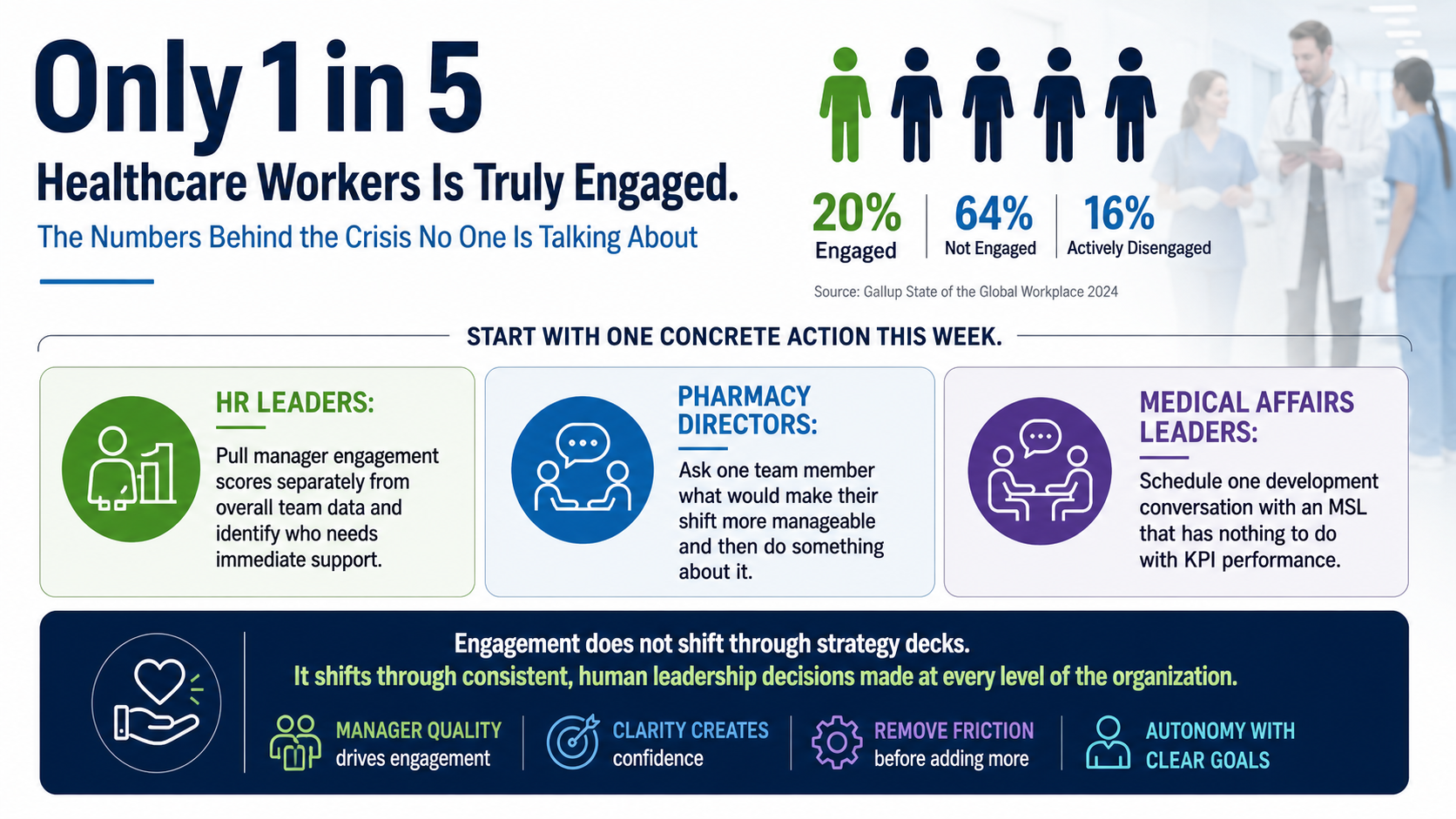
Only 1 in 5 Healthcare Workers Is Truly Engaged. The Numbers Behind the Crisis No One Is Talking About
Gallup’s State of the Global Workplace report shows that employee engagement has fallen from 23% to 21% globally the sharpest drop since COVID-19 lockdowns. In healthcare, that number hits differently. When fewer than 1 in 5 of your pharmacists, MSLs, and medical affairs professionals feel genuinely connected to their work, the cost is not just cultural. It shows up in patient safety events, talent attrition, and the slow erosion of institutional knowledge you cannot afford to lose. This is not a morale problem. It is a leadership and operations problem and it is yours to solve.
Context and Why It Matters
According to Press Ganey’s 2025 Healthcare Employee Experience report, based on feedback from 2.3 million employees, engagement dropped again in 2024, and disengaged employees are now 1.7 times more likely to leave. The turnover rate improved slightly from 20% to 18% but that progress is fragile. Declining engagement could reverse those gains entirely.
For Pharmacy Directors, HR leaders, and Medical Affairs Directors, these numbers translate directly into operational risk. Disengaged employees are 2 times as likely to turn over as their highly engaged peers, and one in five employees left their healthcare organization between 2022 and 2023.
Research from Perceptyx confirms that the gulf between the most engaged healthcare organizations and the rest continues to widen, signaling that urgent action is still needed by most health systems. The organizations pulling ahead are not doing anything radical. They are doing the fundamentals better and with greater intentionality.
Core Insights
1. Pharmacist Disengagement Is Not a Morale Issue. It Is a Structural One.
The 2024 National Pharmacist Workforce Survey found that 36.1% of pharmacists are likely or very likely to search for new employment, and 25.5% plan to leave their current job within the next year. Among ambulatory care pharmacists, burnout rates run as high as 88%. Among pharmacy technicians, that figure reaches 52%.
Pharmacists frequently cite unrealistic performance expectations, limited autonomy, and persistent backlogs as central drivers of emotional exhaustion. Under these conditions, they shift from reflective clinical decision-making to reactive task management, with insufficient time for counseling or complex therapeutic evaluation. That shift does not just harm the pharmacist. It raises medication error risk and degrades the quality of patient care.
For hospital pharmacy leaders, the message is clear: staffing models that prioritize throughput over professional autonomy are actively accelerating turnover.
2. Leader Disengagement Is the Multiplier No One Addresses
Engagement among healthcare leaders has dropped 3.7% over the past three years and it is one of the few roles that has not begun to recover from COVID-induced declines. Gallup’s data shows that behind the global slide in overall engagement was a deeper drop in manager engagement, from 30% to 27%.
This matters because disengaged leaders produce disengaged teams. A Pharmacy Director who feels unsupported by the C-suite, or a Medical Affairs Director navigating constant structural ambiguity, cannot consistently model the clarity, purpose, and psychological safety their teams need to thrive. Investing in leader engagement is not a soft priority. It is the highest-leverage move available to HR leaders in healthcare right now.
3. The Cost of Inaction Is No Longer Abstract
Disengaged teams see turnover rates up to 43% higher than highly engaged teams. On average, it costs $4,700 to hire a new employee, but total costs including recruiting, onboarding, and training can balloon to 3 to 4 times the position’s annual salary. For senior clinical pharmacist roles and Medical Science Liaison positions where specialized expertise and institutional knowledge drive real value that math is sobering.
Perceptyx’s analysis found that effective change management is now the single most critical driver of employee engagement in healthcare organizations, and that employees express a growing need for better clarity, support, and involvement during disruptions. Yet most organizations continue to deploy top-down change with minimal frontline input. The gap between leadership intent and employee experience is where engagement quietly dies.
4. What the Top-Performing Organizations Do Differently
Organizations with highly engaged employees are 3 times more likely to be top performers in patient experience and perform higher in safety outcomes. The best-performing healthcare organizations distinguish themselves through a proactive approach to change that involves and supports their workforce, fostering a culture of continuous improvement.
For Medical Affairs Directors managing MSL teams, this translates to proactive territory communication, meaningful insight-sharing feedback loops, and clear pathways for scientific career advancement. For Pharmacy Directors, it means moving from reactive staffing conversations to structured engagement audits measuring not just vacancy rates but intent-to-stay and psychological safety scores at the department level.
Career and Opportunity Angle
The engagement crisis is reshaping how healthcare organizations recruit and retain top talent. Pharmacy Directors who invest in engagement infrastructure are seeing measurable improvements in retention of clinical pharmacists and pharmacy technicians in hospital pharmacy settings. HR leaders who partner with specialists in pharmacy recruitment services rather than relying solely on job boards are accessing passive candidates who are not actively searching but are absolutely open to a better opportunity.
For Medical Affairs leaders, MSL retention starts at the point of hire. Recruiting professionals who align with your team’s scientific culture and growth trajectory reduces early attrition significantly. As medical affairs recruiter strategies evolve, the organizations winning the talent war are those treating engagement as a hiring criterion, not just a post-hire intervention.
The data is not ambiguous. Fewer than 1 in 5 healthcare workers is truly engaged and in your pharmacy, your MSL team, or your medical affairs department, that statistic is not a number. It is a colleague. It is a pharmacist going through the motions. It is an MSL quietly updating their resume. Ask yourself this week: What does your engagement infrastructure actually look like? If the honest answer is annual surveys and a few wellness initiatives, it is time to go further. Connect with peers. Audit your retention data. And if you are looking to build or rebuild a team with the right people from the start, a Pharmacist Personal Recruiting Service that understands your culture is a strong place to begin.