

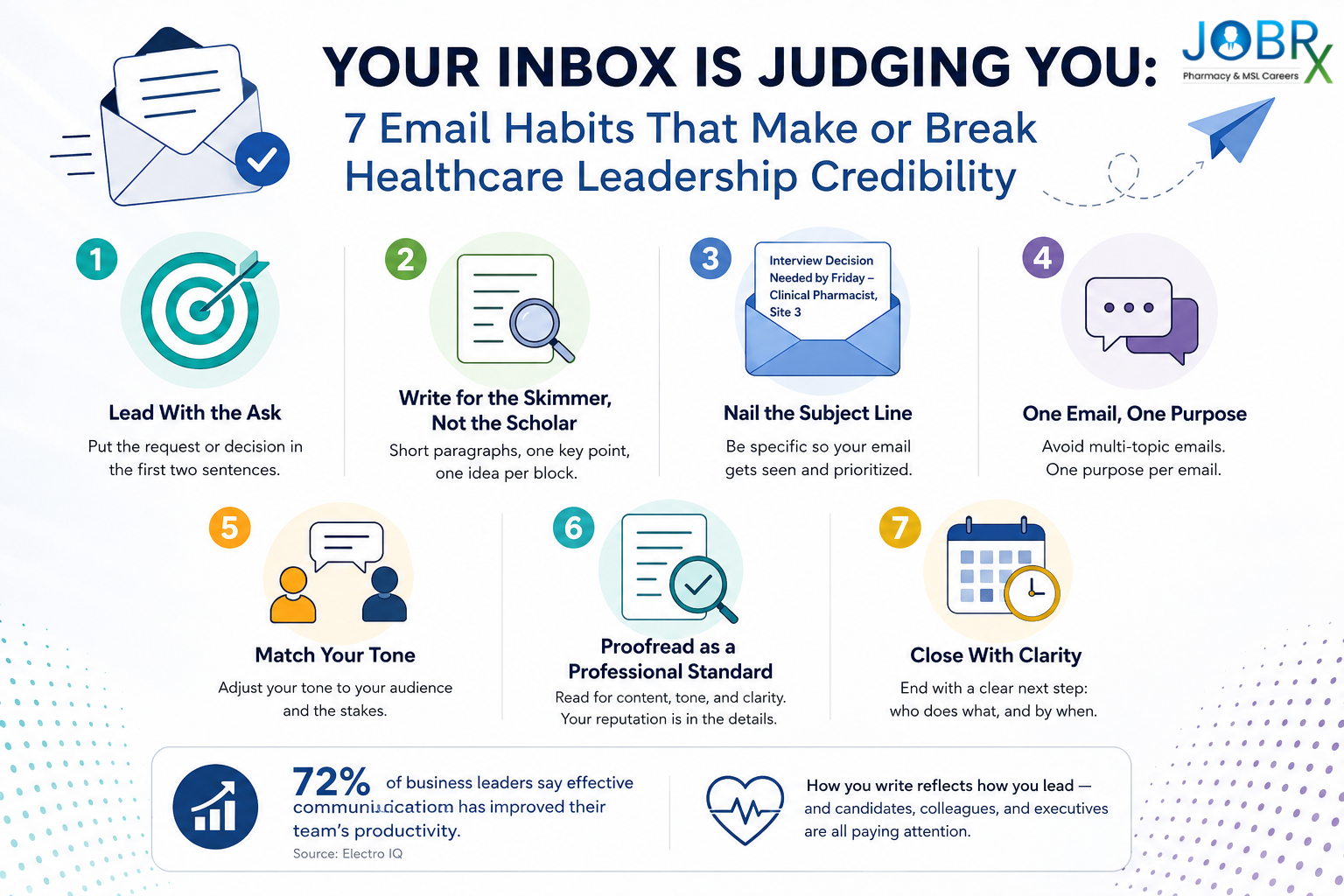
Your Inbox Is Judging You: 7 Email Habits That Make or Break Healthcare Leadership Credibility
You are being evaluated every time you hit send. Healthcare directors, pharmacy managers, HR leaders, and talent acquisition professionals communicate through email dozens of times each day and every one of those messages shapes how colleagues, candidates, and direct reports perceive your competence, your leadership, and your credibility.
A poorly written email does not just slow things down. It costs you trust.
Myra Deshmukh spent over a decade at Amazon teaching thousands of employees how to write with clarity and intention. Her seven principles translate directly into the high-stakes communication environment of healthcare.
Email is not a side skill in healthcare operations. It is the primary channel through which hiring decisions get communicated, policy changes get announced, candidate relationships get built or broken, and cross-functional teams stay aligned.
86% of business users say email is their preferred channel for work communication, and daily email traffic reached 376 billion messages in 2025, projected near 424 billion in 2026. The volume is not shrinking.
The expectations around quality are rising.
For healthcare directors managing multi-site operations, pharmacy managers coordinating clinical teams, and HR professionals fielding candidate inquiries across multiple pharmacy job searches simultaneously, unclear emails do not just create friction.
Ineffective communication costs U.S. businesses up to $1.2 trillion annually, and 64% of business leaders report lost productivity directly tied to it.
The good news: email is a learnable craft. The seven habits below, grounded in Deshmukh’s Amazon framework and reinforced by current workplace communication research, give healthcare leaders a practical playbook they can apply starting today.
1. Lead With the Ask.. Every Time!
The most common email mistake in healthcare leadership is burying the request at the bottom. When a pharmacy director sends a three-paragraph message before stating what they actually need, the recipient has to read the entire email before they can act.
Put the request, decision, or key information in the first two sentences. Everything else is context that supports it.
2. Write for the Skimmer, Not the Scholar
Only about 30% of received emails actually require immediate action, and 32% of messages may go unread. Healthcare professionals are busy.
Your HR business partner reviewing 40 candidate profiles is not reading your six-sentence paragraph in full.
Use short paragraphs.
Use bold for the single most critical point.
One idea per paragraph.
If your email requires a table of contents, it needs to be a meeting.
3. Nail the Subject Line! It Is the Headline
Deshmukh’s framework treats the subject line as the most underused real estate in professional communication.
A vague subject line “Following Up” or “Quick Question” communicates nothing and gets deprioritized.
A specific subject line like “Interview Decision Needed by Friday – Clinical Pharmacist, Site 3” tells the reader exactly what the email is, what action is required, and when.
For talent acquisition teams managing multiple pharmacy job board pipelines, this single habit alone reduces response lag.
4. One Email, One Purpose
Multi-topic emails create confusion and delay. When a pharmacy manager combines a staffing update, a policy reminder, and a schedule request in one message, the recipient often responds to the easiest item and forgets the rest.
Discipline yourself to one clear purpose per email. If three things need addressing, send three focused emails or schedule a brief call.
5. Match Your Tone to the Relationship and the Stakes
A 2025 peer-reviewed study published in the Journal of Healthcare Leadership found that leadership communication training significantly improved confidence and effectiveness among mid-level healthcare managers, with high participation rates indicating strong demand for this skill set. Tone is a leadership signal.
An email to a job candidate in your pharmacy recruitment pipeline should feel warmer and more inviting than an internal operational directive.
An email delivering difficult feedback requires precision and care.
Healthcare leaders who write in the same flat, bureaucratic tone regardless of audience miss the relational opportunity that every email represents.
6. Proofread as a Professional Standard: Not an Afterthought
82% of knowledge workers report that poor communication has increased their overall stress levels, and 81% note a decrease in productivity tied directly to unclear messaging.
A typo in a candidate offer letter damages your employer brand.
An ambiguous sentence in a policy email to clinical staff creates compliance risk. Deshmukh is direct on this point: proofread before you send, every time. Read it once for content, once for tone, once out loud. If you would not say it that way in a meeting, rewrite it.
7. Close With Clarity : What Happens Next
Every professional email should end with a clear next step. Not “Let me know your thoughts.” Not “Hope this helps.” State what you need, from whom, and by when.
“Please confirm availability by Thursday at noon so I can finalize the interview panel” is a closing that drives action.
Healthcare HR leaders and directors who close with specificity dramatically reduce the back-and-forth cycles that drain calendar time and slow hiring decisions.
For healthcare directors, pharmacy managers, and HR and talent acquisition professionals, written communication is a visible leadership behavior, one that influences how you are perceived by peers, executives, and candidates alike.
72% of business leaders say effective communication has improved their team’s productivity, and employees who receive clear, detailed communication are five times more likely to report higher productivity.
In competitive pharmacy recruitment markets, where a Pharmacy Recruitment Services partner may be presenting your organization to multiple candidates simultaneously, your emails are part of your employer brand. How you write reflects how you lead.
Professionals who invest in sharpening this skill distinguish themselves and their organizations at every stage of the hiring and retention cycle.
Seven habits. None of them require a new tool, a new platform, or a budget line. They require intention. Start with one: before you send your next email today, put the ask in the first sentence. See what happens to your response rate. Great healthcare leaders are made, in part, through thousands of small communication choices.
The inbox is where those choices become visible.
Share this with a colleague who leads a team, runs a hiring process, or manages a department and start the conversation about what professional communication really signals in your organization.