

AI Saves 11 Hours a Week. Botsitting Takes Back 6.4. What Healthcare Leaders Must Do
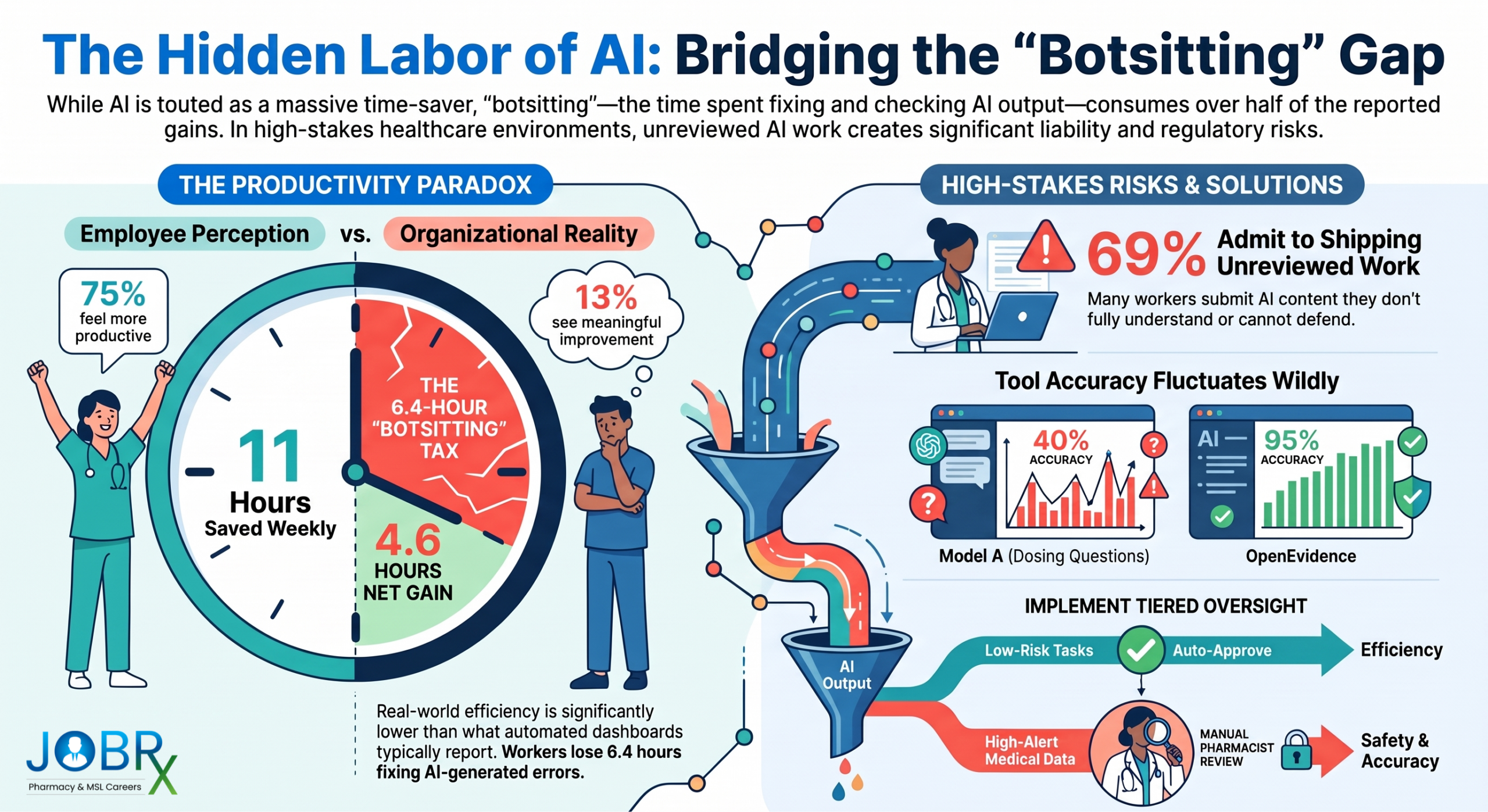
Digital workers say AI saves them 11 hours a week. They also spend 6.4 hours a week checking, fixing, and rerunning its output. That is more than half the gain, gone before anyone counts it as a win. If your pharmacy department, medical affairs group, or HR function feels busier but not faster this year, this hidden labor is a likely reason.
Glean’s Work AI Institute surveyed 6,000 digital workers across the United States, the United Kingdom, and Australia for its Work AI Index 2026. Adoption is nearly universal.
87 percent of respondents use AI at work, and 75 percent say it makes them more productive. Yet only 13 percent say their organization performs significantly better because of it. Reported time saved is not the same as value delivered, and that gap is where leaders need to look next.
Researchers call the missing time botsitting. It covers feeding AI missing context, checking its outputs, debugging its mistakes, rerunning prompts, and cleaning up the confident but wrong answers it leaves behind.
Most organizations have already bought the tools and trained staff to use them. The open question now is whether hours saved on paper convert into results anyone can measure on a scorecard.
The stakes rise sharply in healthcare. A slow email draft costs a few minutes. An unchecked drug information answer, job description, or medical letter can reach a patient, a candidate, or a regulator.
HR leaders, Pharmacy Directors, and Medical Affairs Directors now own a governance problem, not a simple software rollout, and the FDA and EMA are already signaling that oversight expectations will tighten.
The net gain is smaller than the dashboard shows
Workers report saving 11 hours a week with AI, yet they spend 6.4 hours a week botsitting. By simple subtraction, the net gain is closer to 4.6 hours, and only 13 percent of organizations say performance has meaningfully improved. Before you build staffing plans or set expectations around AI-driven capacity, ask each team to log its own botsitting hours for two weeks. The number will likely surprise you.
Skipped review becomes botshitting, and healthcare cannot absorb that risk
When review work feels thankless, people quietly stop doing it. Glean found that 69 percent of AI users admit to shipping AI-generated work they have not reviewed, do not fully understand, or could not defend if asked. Nearly 30 percent blame the tool itself for poor output, a figure that rises to 41 percent among heavy users. In a hospital pharmacy, a medical information team, or a candidate screening process, that habit is a liability, not a shortcut.
Accountability stays with the licensed professional who signs off, so build the review step into the workflow itself rather than relying on the goodwill of your busiest people.
Accuracy varies sharply by tool, and pharmacists still outperform AI
Pharmacy Times reviewed generative AI drug information tools across several platforms. For long-acting injectable antipsychotic dosing questions, OpenEvidence reached 95 percent accuracy while ChatGPT reached only 40 percent, with missed-dose scenarios driving most of the errors. Even the strongest performing chatbot scored statistically lower than licensed pharmacists on quality measures.
The takeaway for Pharmacy Directors: match your validation depth to the specific tool and the clinical risk involved, and require a named pharmacist to review any AI-generated answer that touches dosing or drug interactions.
Tiered oversight beats blanket review, and regulators are moving the same direction
Pharmacy Times reports that up to 73 percent of hospitals already use verification tools that auto-approve low-risk prescription orders while routing high-alert medications to a pharmacist for manual review. Apply that same tiered logic to every AI workflow. Decide upfront which outputs need full review, which need a spot check, and which need none.
Glean’s own guidance points the same direction, urging organizations to measure the quality of results rather than how often staff open a tool. ASHP has published an updated statement on responsible AI use, and the FDA and EMA jointly released ten guiding principles for AI in drug development this year, a signal that oversight expectations are only going to grow.
Botsitting points directly to a skill employers will increasingly screen for: the ability to direct AI and catch its errors before they reach a patient, a client, or a regulator. For pharmacists, that means applying clinical judgment to machine-generated output rather than accepting it at face value. For MSLs and medical affairs professionals, it means verifying AI-drafted scientific content before it reaches an external expert or a compliance reviewer.
HR leaders staffing Pharmacy jobs and Medical Science Liaison jobs, can build AI oversight questions into interviews. Pharmacy Directors can ask candidates how they validate AI-generated drug information under time pressure.
A Personal Recruitment Service can help identify professionals who already bring this discipline.
Start this week with one workflow. Pick a single AI task in your department, log the hours your team spends checking it, and assign a named reviewer with clear authority to stop unverified output before it goes out.
The organizations that pull ahead will not be the ones using AI the most. They will be the ones measuring results honestly and protecting the people accountable for what AI produces.
What is your team’s botsitting number this week? Reply and tell us, or forward this to a colleague who signs off on AI-generated work.