

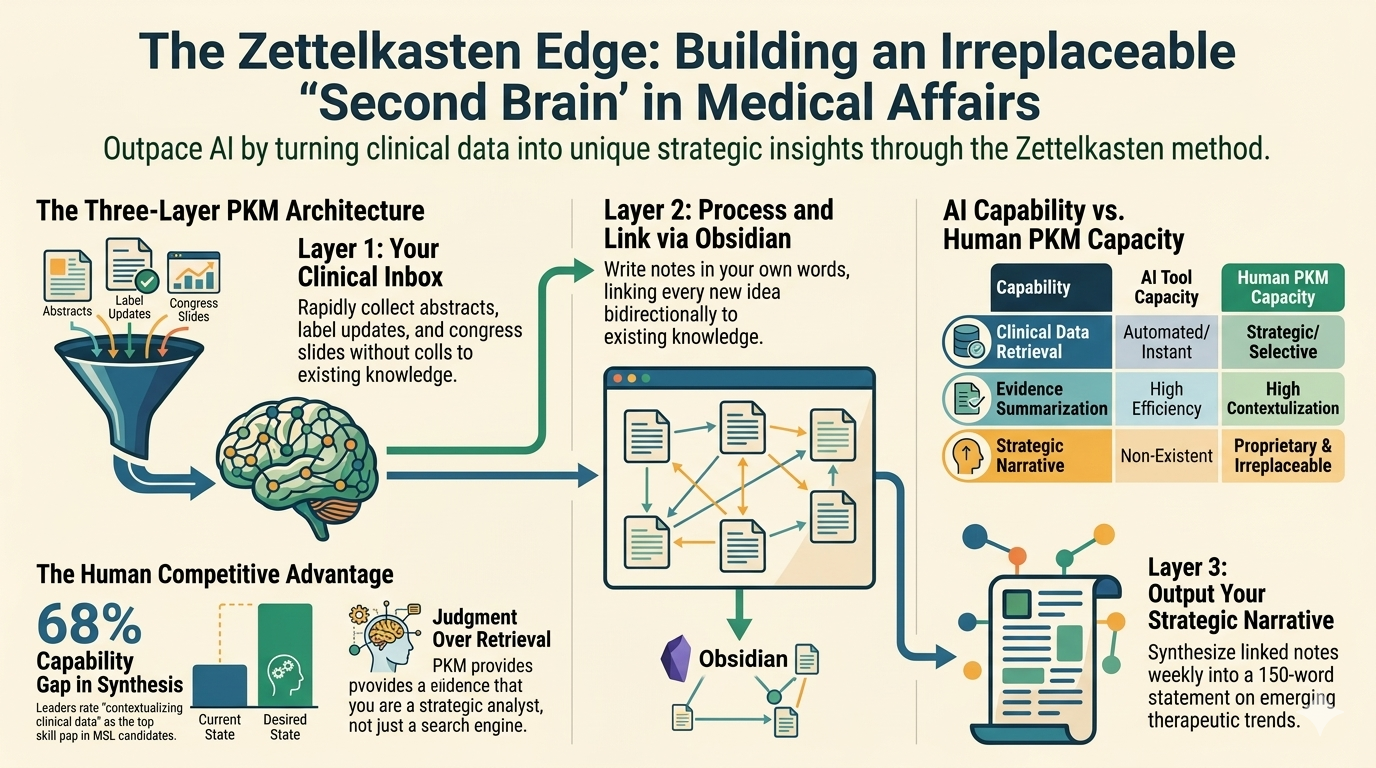
Personal Knowledge Management for MSLs & Pharmacists: How to Build the One Asset AI Cannot Copy
Personal knowledge management (PKM) is now the defining skill separating elite MSLs and pharmacists from replaceable ones in 2026. While AI tools can retrieve any clinical trial in seconds, they cannot build your network of connected insight. This newsletter shows you exactly how to implement a Zettelkasten-based PKM system to turn scattered data into a strategic narrative that gets you hired — and keeps you irreplaceable.
The “Second Brain” for MSLs & Pharmacists: Outpacing AI with Personal Knowledge Management
Knowing the data is no longer your competitive advantage. Connecting it is.
Every MSL candidate walking into a KOL meeting in 2026 has access to the same PubMed alerts, the same congress abstracts, the same AI-generated summaries. So does your competition. So, frankly, does ChatGPT.
The question hiring managers and medical affairs directors are now asking is not “Do you know the MONARCH-3 data?” It is: “What do you do with it that no one else does?”
The answer, for the most hireable professionals in pharma and biotech right now, is a Personal Knowledge Management (PKM) system specifically, one built on the Zettelkasten method.
What Is a Zettelkasten, and Why Should a Pharmacist Care?
Zettelkasten (German for “slip-box”) is a note-linking methodology developed by sociologist Niklas Luhmann, who used it to produce over 70 books and 400 academic articles. The core mechanic: every note you write links bidirectionally to at least one other note, forcing you to ask, “Where does this connect?”
For an MSL or clinical pharmacist, this means:
- A Phase III trial note links to a mechanism-of-action note, which links to a patient-profile note, which links to a competitor comparison note.
- Over time, you don’t have a folder of files. You have a web of insight a map only you built, from your field experiences, your KOL conversations, and your therapeutic area expertise.
A 2024 survey by the Medical Affairs Professional Society (MAPS) found that 68% of medical affairs leaders rated “synthesizing and contextualizing clinical data” as the top capability gap in MSL candidates. PKM directly closes that gap.
The Three-Layer PKM Architecture for Healthcare Professionals
Layer 1: Capture (Your Inbox). Tools: Readwise, Zotero, Notion, or Apple Notes. Every abstract, label update, or congress slide you encounter goes here within 24 hours. No processing yet. Just capture.
Layer 2: Process (Your Zettelkasten) Tools: Obsidian (most recommended for pharma professionals due to its offline capability and local storage relevant for compliance-conscious environments) or Roam Research.
Here is where you write your own words on what a piece of data means, then tag it and link it. One note = one idea. Not one paper, one idea.
A Phase II readout showing a 23% reduction in hospitalizations means nothing in isolation. In your Zettelkasten, it sits next to your note on the ICER cost-effectiveness threshold, your KOL’s comment from last month’s advisory board, and the payer formulary position you researched for your last interview. Now it’s a narrative.
Layer 3: Output (Your Strategic Narrative). This layer separates PKM from simple note-taking. Once per week, spend 20 minutes reviewing your linked notes and write one “synthesis note” a 150-word statement of what you believe the emerging story is in your therapeutic area.
This synthesis note is what you bring to KOL meetings. It is what you put in your cover letter. It is what you say when a hiring manager asks, “What’s your read on where this space is heading?”
Why AI Cannot Replicate This and Why That’s Your Hiring Edge
AI is extraordinarily good at retrieval and summarization. It is structurally poor at personal synthesis — the kind built from a combination of your field experience, your KOL relationships, your institutional knowledge, and your career-specific perspective.
McKinsey’s 2025 Future of Work in Life Sciences report estimated that 42% of data-retrieval tasks currently performed by MSLs will be automated by AI tools by 2027. The roles that survive — and the candidates who get hired — will be those who demonstrate judgment, not just knowledge.
A PKM system is the infrastructure for demonstrating judgment. It is evidence, in a job interview, that you are not a search engine. You are an analyst.
 “The MSLs who stand out in 2026 are the ones who walk in with a point of view, not a printout. I can get a printout from five AI tools before the meeting starts.” — Dr. Sarah Lim, VP Medical Affairs, Mid-Size Oncology Biotech
How to Start This Week A 3-Step Implementation Plan
Step 1: Download Obsidian (free). Create three folders: Inbox, Zettelkasten, Synthesis.
Step 2: Take the last clinical paper you read. Write three sentences in your own words — what it found, what it means for patients, and what question it raises. Link it to one other note you already have. That is your first Zettel.
Step 3: Set a 20-minute weekly “synthesis session” on your calendar. Review your linked notes. Write one synthesis note. In 90 days, you will have a proprietary knowledge map no AI can generate.
What This Means for Your Career:
For MSL jobseekers: PKM gives you a concrete, demonstrable answer to the most common medical affairs interview question — “How do you stay current and synthesize complex data?” that goes beyond “I read journals.” It shows process, discipline, and strategic thinking.
For pharmacists transitioning to industry: Your clinical depth is your raw material. PKM is the system that converts it into the Medical Affairs currency hiring managers are actually buying.
| Capability
|
AI Tool
|
MSL with PKM System
|
|---|---|---|
| Retrieve trial data |  Instant Instant |
Instant |
| Summarize an abstract | Seconds |
With annotation |
| Link data to KOL context |  No access No access |
Core function |
| Build a TA narrative over time | No memory |
Compounding asset |
| Demonstrate judgment in interviews | |
Differentiator |