

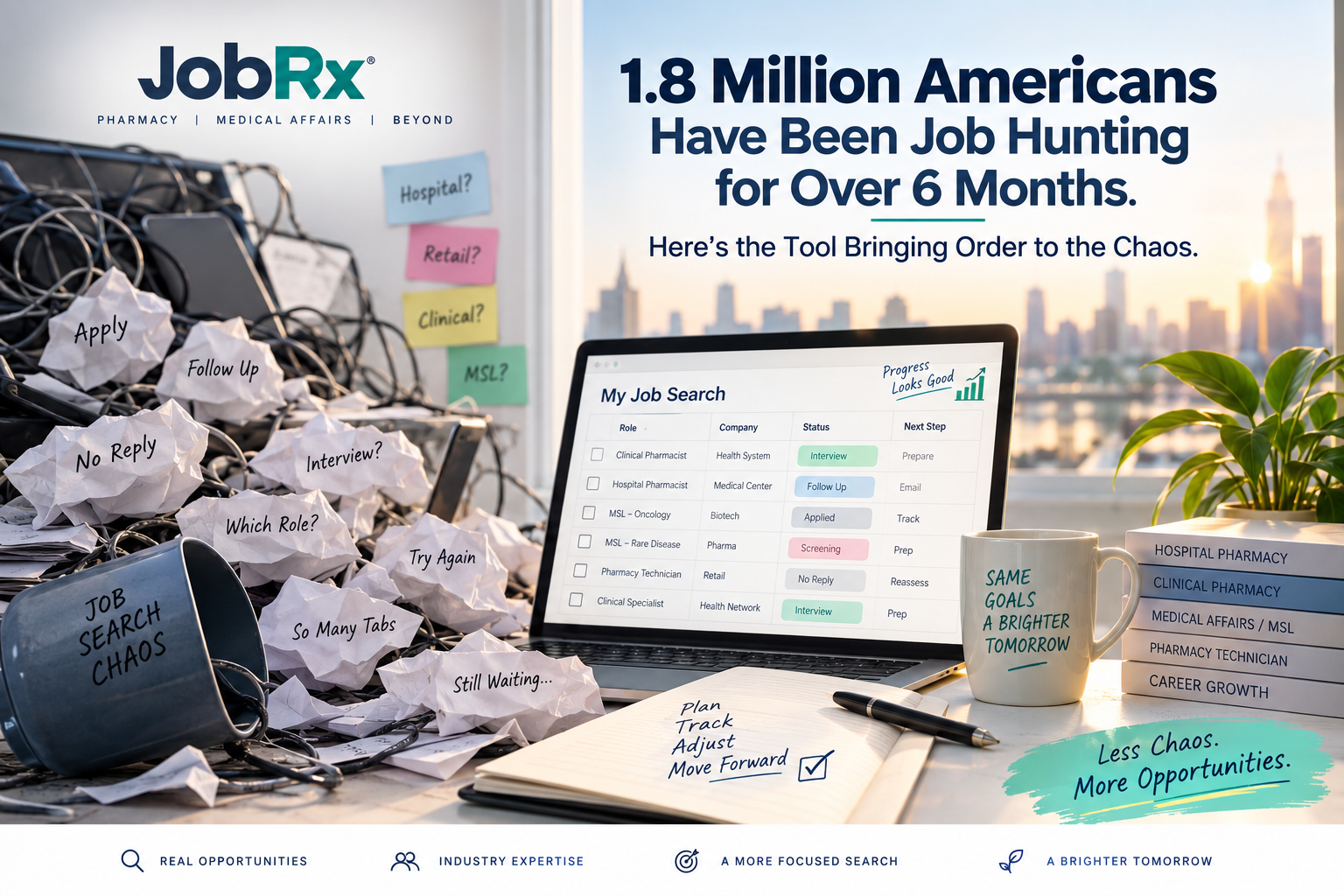
“1.8 Million Americans Have Been Job Hunting for Over 6 Months. Here’s the Tool Bringing Order to the Chaos.”
Roughly 1 in 4 unemployed Americans, about 1.8 million people, have been job hunting for more than six months.
If you are a pharmacist, pharmacy technician, or MSL candidate who feels like your search has stretched longer than it should, you are not imagining it. The market shifted, and your strategy needs to shift with it.
U.S. employers added just 181,000 jobs in 2025, according to revised Bureau of Labor Statistics data, down sharply from 1.46 million in 2024. That revision made 2025 the weakest year for hiring since 2003, outside of a recession year.
Pharmacy and medical affairs candidates are feeling the ripple effects. More applicants are competing for fewer clearly defined openings, and searches that once took weeks now stretch into months.
For pharmacists and pharmacy technicians hunting for hospital, clinical, or retail roles, and for MSL candidates targeting competitive therapeutic areas, this means the old approach of applying and waiting no longer works.
Candidates need structure, tracking, and a system that turns a chaotic search into a manageable process. That is exactly what a growing number of job seekers are building for themselves, and it is a lesson worth borrowing.
1. Spreadsheets Are Becoming a Career Survival Tool Job seekers interviewed by CNBC say a simple spreadsheet tracking applications, follow-ups, and interview stages gives them something the market currently will not: a sense of control.
One long-term job seeker who eventually landed a managed services role called it a way to “bring order to the chaos.” For pharmacists and pharmacy technicians applying across multiple health systems, or MSL candidates targeting several therapeutic areas at once, this kind of tracking system prevents missed follow-ups and reveals patterns, like which resume version or which type of role is generating callbacks.
2. Licensure Success Is Trending Up, Which Raises the Bar The National Association of Boards of Pharmacy reported a 2025 mean first-time NAPLEX pass rate of 85.7%, up sharply from prior years. That is good news for new graduates, but it also means more licensed pharmacists are entering an already competitive applicant pool.
Standing out now requires more than passing the boards. It requires a clearly documented search strategy and a resume that speaks directly to what hiring managers in hospital and clinical settings are prioritizing.
3. Hospital and Clinical Settings Are Where the Growth Is Pharmacy Times and industry labor projections continue to point to non-retail settings, hospitals, health systems, and outpatient care, as the fastest-growing segment of pharmacist employment, while traditional retail roles remain flatter.
For job seekers, this means a search spreadsheet should do more than log applications. It should track which practice settings are actually responding, so time gets invested where hiring momentum exists.
4. MSL Hiring Has Tightened Around Therapeutic Area Fit Recent Medical Science Liaison market data shows that field medical leadership roles are in their tightest supply in five years, and that therapeutic area alignment is now the single strongest predictor of a successful hire, outperforming even significant compensation increases.
For MSL candidates managing applications across oncology, rare disease, or immunology openings, a tracking system that flags TA match, not just job title, can meaningfully shorten the search.
A prolonged search is not a reflection of your qualifications. It is a reflection of a labor market moving more slowly than it has in over two decades outside a recession.
The candidates finding success right now are the ones treating their search like a project: documented, measurable, and adjusted based on real data.
That mindset also happens to be exactly what hiring managers want to see once you are in the interview chair.
Whether you are searching for hospital pharmacy jobs, clinical pharmacist jobs near you, or remote Pharmacists jobs, working with a Personal recruitment service who already tracks which employers are actively hiring can compress months of guesswork into a focused, targeted search.
If your search has felt like chaos lately, you are in good company, and there is a way through it. Build your own tracking system this week. Log every application, every follow-up, and every response. Patterns will emerge faster than you expect. And if you want a partner who already has that data built for pharmacy and medical affairs roles, reach out.
We would be glad to help bring order to your search too.