

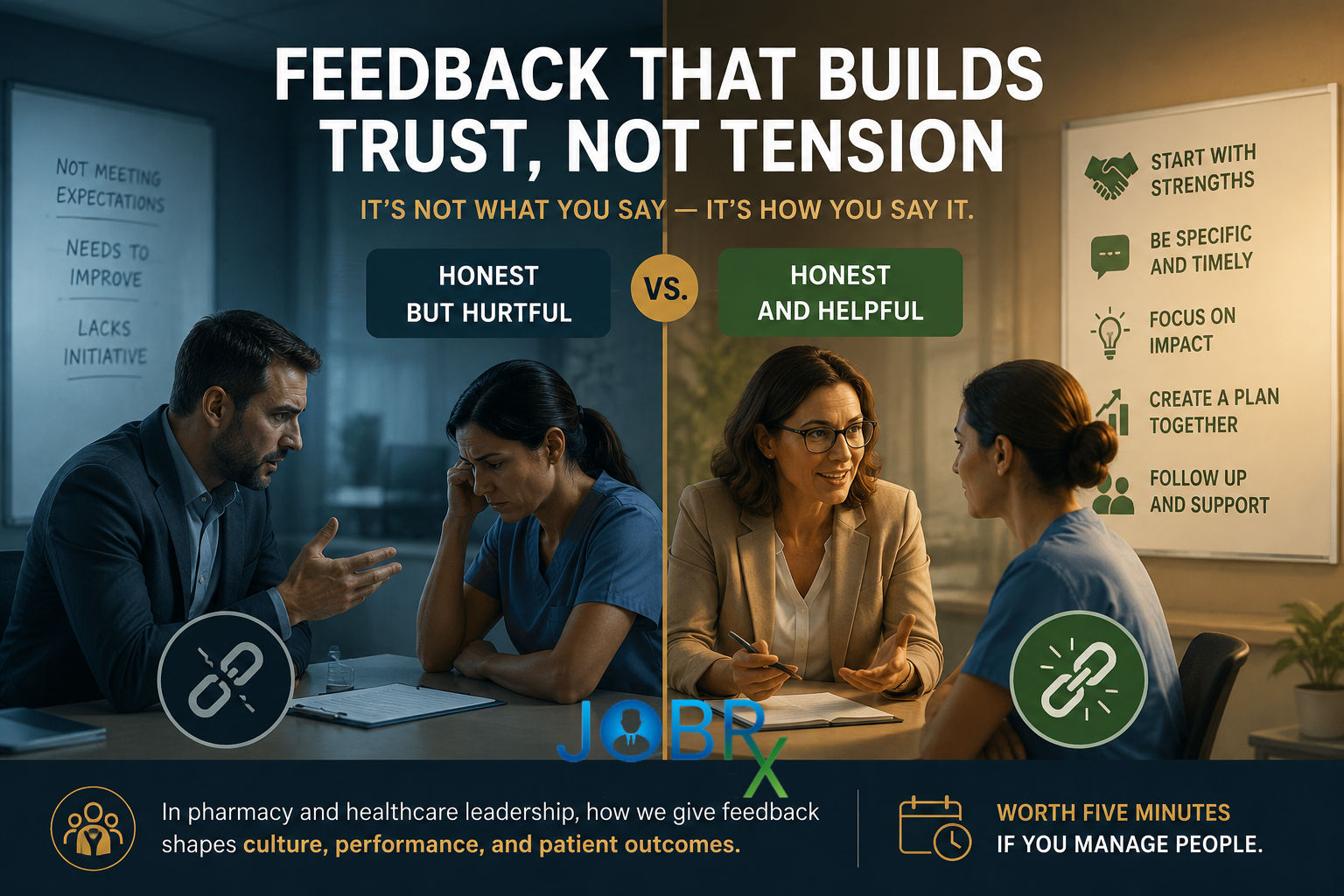
The Feedback Gap: Why Your Best Managers Still Get It Wrong
A manager delivers what they believe is honest, direct feedback. The employee hears an attack. Both walk away frustrated, and the behavior never changes. This gap between intent and impact happens in performance reviews every week, and it is quietly costing organizations their best talent.
The problem is rarely a lack of courage. It is a lack of structure.
Feedback failures are not new, but the cost of getting them wrong has changed. Talent is harder to retain, expectations around psychological safety have risen, and employees now compare how they are managed against how they could be managed elsewhere.
For Directors, HR leaders, and Talent Acquisition teams, feedback culture has become a retention lever, not a soft skill.
Research summarized by Harvard Business Review shows that criticism which shames or attacks character shuts employees down instead of helping them improve. Meanwhile, in healthcare specifically, workforce pressure is intensifying.
Pharmacy leaders report technician turnover exceeding 20 percent in 2026, and executives increasingly point to psychological safety and structured feedback as the differentiator between teams that retain talent and teams that bleed it. Getting feedback right is no longer optional.
It is a business function.
1. Structure beats instinct.
Vague criticism reads as judgment. Feedback that names a specific behavior, explains why it matters, and outlines a clear next step gives employees something to act on instead of something to defend against.
Skipping any one of these three elements increases the odds the feedback lands as an attack rather than as guidance.
2. Timing changes outcomes.
Leaders who open a project with sincere, specific encouragement build enough trust that midpoint critique gets received as coaching, not judgment. Waiting until year-end reviews to deliver hard feedback removes the runway employees need to actually course-correct.
3. Feedback-seeking must be modeled, not mandated.
Teams stay quiet not because they lack courage, but because they are unsure feedback is genuinely welcome. Leaders who visibly ask for feedback themselves, and act on it, lower the perceived risk for everyone below them.
This single behavior is one of the fastest ways to shift team culture.
4. Compensation conversations and performance conversations should not collide.
When critique is delivered in the same breath as a pay or rating discussion, employees become defensive rather than receptive.
Separating developmental feedback from compensation decisions, and explaining the reasoning behind evaluations, measurably reduces resentment and builds trust in the process.
For HR and Talent Acquisition leaders, feedback competency is quietly becoming a hiring criterion. Health systems are restructuring pharmacy leadership roles around exactly this skill set.
Becker’s Hospital Review reports that the next generation of pharmacy leadership is being defined by the ability to build psychologically safe, accountable teams, not just operational oversight. If your organization is hiring or promoting into Director-level roles, screening for structured feedback ability, not just clinical or operational credentials, is becoming a real differentiator.
Candidates who can demonstrate this skill are increasingly the ones organizations are competing for through pharmacy recruitment services and leadership pipelines.
Every performance conversation is a chance to build trust or quietly erode it. The managers who get this right are not naturally gifted communicators. They follow a structure, they time it well, and they model the behavior they want to see.
Take one feedback conversation you have coming up this week and run it through this lens. Then tell us how it landed.