

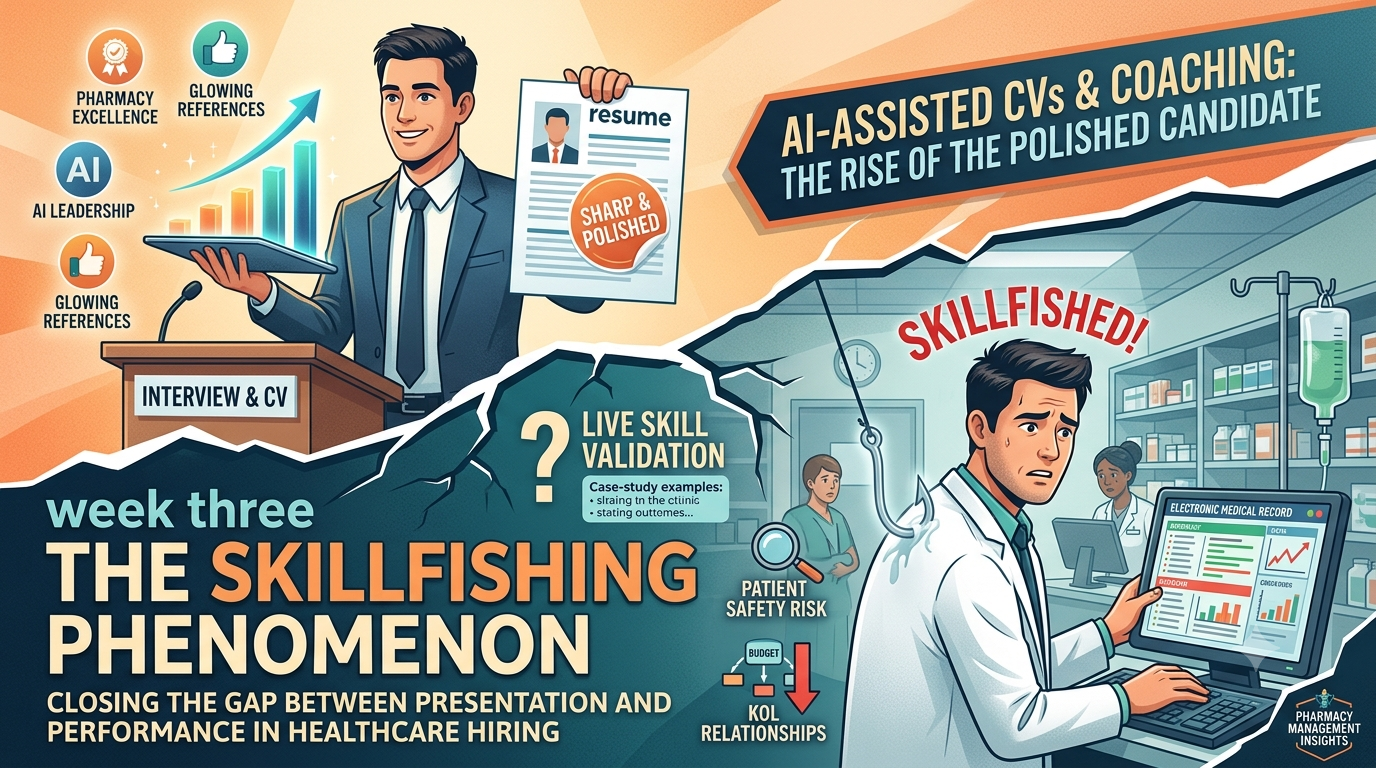
Are Skillfishers Slipping Into Your Pharmacy Hires?
You extended the offer. The resume was sharp, the interview was confident, and the references were glowing. Then week three arrived, and the cracks started showing. The clinical judgment wasn’t there.
The KOL relationships were surface-level. The formulary management experience was more shadow than substance.
If this sounds familiar, you have likely been skillfished, and in pharmacy and medical affairs hiring, the cost of that mistake runs far deeper than a wasted onboarding budget.
Skillfishing is the term coined by SHRM to describe the growing gap between how candidates present their abilities during the hiring process and how they actually perform once the work begins.
It is not a new phenomenon, but AI has accelerated the trend, making it easier than ever for candidates to build a polished professional narrative that may not reflect genuine depth.
For Pharmacy Directors, HR leaders in health systems, and Medical Affairs hiring managers, the stakes are uniquely high. In Skillsoft’s Global Skills Intelligence Survey, 91% of HR professionals said they believe employees overstate their skill proficiency, particularly in AI, leadership, and technical domains.
In pharmacy and medical affairs, a misaligned hire is not just an HR problem. It disrupts patient safety protocols, stalls KOL engagement strategies, delays formulary decisions, and strains already lean teams.
With hospital pharmacy labor costs rising and medical affairs teams under pressure to demonstrate measurable value, a bad hire in 2026 is a budget event, not just a people problem.
1. AI Has Raised the Presentation Bar, Not the Performance Bar
AI-assisted resume and cover letter writing, rapid online credentialing, polished LinkedIn profiles, and interview coaching have raised the bar for presentation. A candidate can project deep expertise before they have actually developed it, creating a widening gap between how candidates appear and what they can realistically deliver on day one.
For MSL hiring managers, this is especially acute. A candidate who lists “KOL engagement,” “medical communications,” and “HEOR data interpretation” on a resume built with AI tools may have theoretical familiarity with each, but zero field application. The resume will look identical to one written by a 10-year veteran. Traditional screening was not designed to tell the difference.
2. Traditional Interviews Are No Longer Sufficient
SHRM’s Johnny C. Taylor Jr. put it plainly: do not let candidates get away with generalities. When a candidate says they led formulary reviews or managed oncology field medical strategy, the follow-up questions matter more than the original answer. What was the situation? What decisions did they make? What trade-offs did they consider? What went wrong?
Real experience has texture. It includes setbacks, course corrections, and lessons learned. A clinical pharmacist who genuinely managed antimicrobial stewardship will describe the resistance patterns they encountered, the prescriber pushback they navigated, and the metrics they tracked. Someone working from a polished script will stall after the first layer of follow-up.
3. Fewer Than Half of Organizations Verify Skills in Real Time
Skills-based hiring increases risk when fewer than half of organizations verify skills live, enabling skillfishing. That number should concern every Pharmacy Director and Medical Affairs leader reading this. Credential review and reference calls remain the dominant verification method, yet both are easily manipulated.
References can be coached, and a polished resume, strong communication style, and confident interview manner contribute to the misconception that a star is about to be hired.
The organizations closing this gap are moving toward live skill validation. That means case-based problem solving in the interview, a realistic job preview, or a structured scenario that mirrors an actual challenge the candidate would face in the role.
4. Rigorous Hiring Does Not Have to Feel Adversarial
A common concern among hiring managers is that adding assessment layers will deter top candidates or slow an already stretched recruitment process. The evidence says otherwise. Leading teams are moving toward live problem-solving as AI-generated resumes become easier to produce.
Strong candidates, the ones you actually want, generally welcome thoughtful evaluation. They understand that substance-focused hiring signals a high-performing team.
For pharmacy recruitment specifically, practical assessments can be straightforward: a clinical scenario review, a mock P&T committee question, or a field medical planning exercise for MSL candidates. These do not need to be lengthy. They need to be realistic and role-specific.
For Pharmacy Directors and Medical Affairs leaders managing open requisitions, the skillfishing trend reinforces why partnering with a specialized pharmacy recruitment service or medical affairs recruiter adds measurable value.
Pharmacy headhunters who work exclusively in these spaces have already built verification into their process: clinical credential review, competency-based interview frameworks, and reference checks conducted by people who understand the difference between a pharmacist who managed a formulary and one who attended a committee meeting.
If your organization relies on a general HR process to hire clinical pharmacists, hospital pharmacy leaders, or MSLs, you are likely not catching skillfished candidates until they are already on your payroll.
Pharmacy recruitment services built around clinical depth, not resume polish, are the structural answer to a structural problem.
Skillfishing is not going away. As AI tools become more sophisticated, the gap between how candidates present and how they perform will keep widening, unless hiring processes evolve alongside it.
The Pharmacy Directors and Medical Affairs leaders who build verification into every stage of the process, not just the interview, will protect their teams, their budgets, and their patients.
Start with one change: the next time a candidate gives you a polished answer, ask one more question. What went wrong, and what did you do differently the next time? The answer will tell you everything.