

Why Your Best Talent Is Already Looking—And How to Stop It
“The Five Feelings That Retain Your Best Talent: Why Pharmacy, Medical Affairs, and HR Leaders Can’t Afford to Miss This”
Four separate crises. One root cause. Replacing a single RN costs $61,110—an 8.6% year-over-year increase. DotMed Healthcare organizations achieved lower portions of their hiring goals in 2025 than in 2024. GoodTime Pharma and biotech saw 24,000 layoffs in 2024; many professionals are underemployed or accepting roles below their experience level. Kempsconnections Whether you lead pharmacy operations, medical affairs strategy, or HR talent management, you’re fighting the same invisible enemy: people feel powerless, undervalued, and trapped. Marcus Buckingham‘s new research reveals why—and what to do about it.
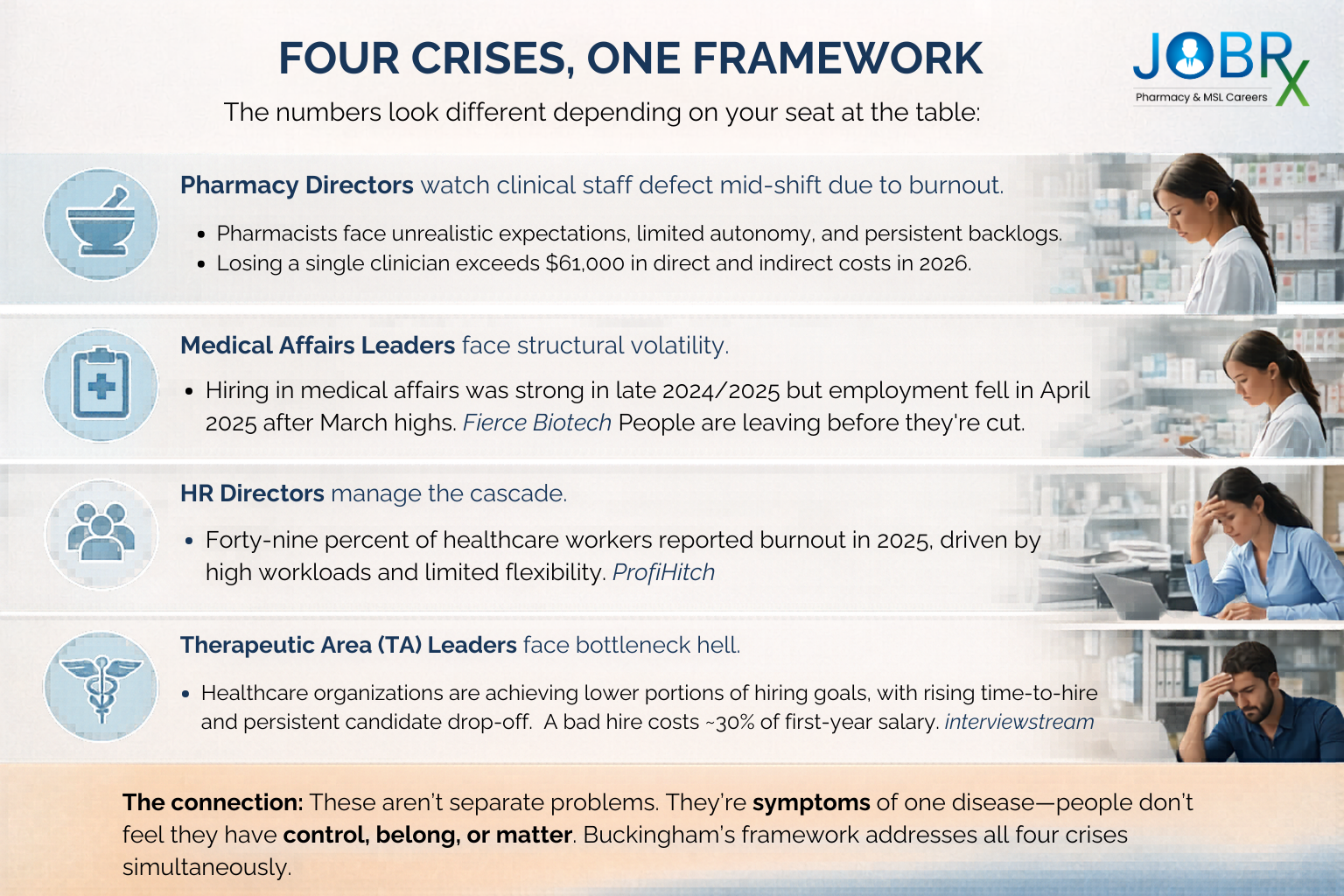
FOUR CRISES, ONE FRAMEWORK
The numbers look different depending on your seat at the table:
Pharmacy Directors watch clinical staff defect mid-shift due to burnout. Pharmacists describe unrealistic expectations, limited autonomy, and persistent backlogs as central drivers of emotional exhaustion. Frontiers The cost? Losing a single clinician exceeds $61,000 in direct and indirect costs in 2026. The AGA Group
Medical Affairs Leaders face structural volatility. Hiring in medical affairs was strong in late 2024/2025 but employment fell in April 2025 after March highs. IntuitionLabs Novartis announced 58 layoffs targeting medical affairs between late 2025 and mid-2026. Fierce Biotech People are leaving before they’re cut.
HR Directors manage the cascade. Forty-nine percent of healthcare workers reported burnout in 2025, driven by high workloads and limited flexibility. Profihitch Your workforce is disengaging.
Therapeutic Area (TA) Leaders face bottleneck hell. Healthcare organizations are achieving lower portions of hiring goals, with rising time-to-hire and persistent candidate drop-off. GoodTime A bad hire costs ~30% of first-year salary. interviewstream
The connection: These aren’t separate problems. They’re symptoms of one disease—people don’t feel they have control, belong, or matter. Buckingham’s framework addresses all four crises simultaneously, but you need to know where to start.
THE FIVE FEELINGS
1. CONTROL:
Pharmacy Directors, your staff needs autonomy over workflows. Professional autonomy and leadership—empowering pharmacists with authority over workflow decisions and medication-safety processes—reduce burnout and improve safety. KevinMD
Medical Affairs Leaders, your specialists need authority over research agendas. When outcomes researchers spend 60% of time in administrative compliance rather than designing health economic models, they lose ownership.
HR/TA Leaders, your teams need control over hiring velocity. Hiring slowdowns are driven by interviewer capacity and follow-through, not sourcing alone—limited pools of available interviewers constrain throughput. GoodTime Empower TA teams to streamline scheduling, decision-making, and credentialing.
The ROI: Having a voice and autonomy at work improves well-being as internal cognitive resources are used for work success rather than self-preservation. PubMed Central
2. HARMONY: Psychological Safety
All four roles need this—but it manifests differently.
Pharmacy: Staff fear reporting near-misses due to blame culture. Good patient and organizational outcomes are influenced by workflows that generate autonomy for health professionals. PubMed Central
Medical Affairs: Specialists withhold concerns to protect research agendas or avoid appearing critical.
HR/TA: Recruiting teams avoid escalating hiring delays or bad interview feedback.
The fix: Effective leadership has been associated with higher levels of psychological safety, team learning, and performance in various healthcare settings. Sage Journals Leaders who normalize speaking up and reward candid feedback create climates where people perform.
3. SIGNIFICANCE:
Early-career professionals leave because they feel removed from decision-making. The AGA Group
Pharmacy: Technicians manage 300 prescriptions daily—unseen.
Medical Affairs: Coordinators design compliance frameworks—unrecognized.
HR: Specialists build benefits programs touching 500+ employees—overlooked.
TA: Professionals fill critical roles in 45 days—no fanfare.
Action: Cross-functional visibility. Public recognition of wins. Quarterly all-hands where every function shares metrics. Pharmacy: “Prevented 24 errors.” Medical Affairs: “Accelerated regulatory submission 6 weeks.” HR: “Reduced claims processing from 14 days to 3.” TA: “Filled critical roles 30% faster than benchmark.”
4. WARMTH OF OTHERS:
A sustainable retention strategy in 2026 is built on structure, clarity, and trust. The AGA Group Healthcare organizations silo functions to the breaking point. Cross-functional mentorship (pharmacy leaders advising TA on role design), shared KPIs, and collaborative problem-solving signal: Your work connects to the mission.
5. GROWTH:
When professionals feel they have control over their schedule and leadership communicates clearly, they are more likely to stay engaged. The AGA Group
- Pharmacy: Clinical certifications, leadership training
- Medical Affairs: Health economics credentials, regulatory expertise, executive track
- HR: Talent strategy, organizational design, SHRM certification
- TA: AI-driven sourcing, skills assessment, talent strategy
CALL TO ACTION
In 2026, losing a single clinician exceeds $61,000 in costs. However, the financial impact is only part of the issue. The larger concern is what happens before the resignation—disengagement, withdrawal, reduced accountability. The AGA Group
You can’t out-recruit a culture problem. But you can design one intentionally.
This week, answer one question for your role:
- Pharmacy Director: Which clinical workflow decision can you decentralize today?
- Medical Affairs Leader: What research autonomy can you restore to specialists?
- HR Director: What recognition program would make teams feel visible?
- TA Leader: Which interview bottleneck can you eliminate this month?
The organizations that win in 2026 won’t hire differently. They’ll make people feel valued before those people start looking elsewhere.