

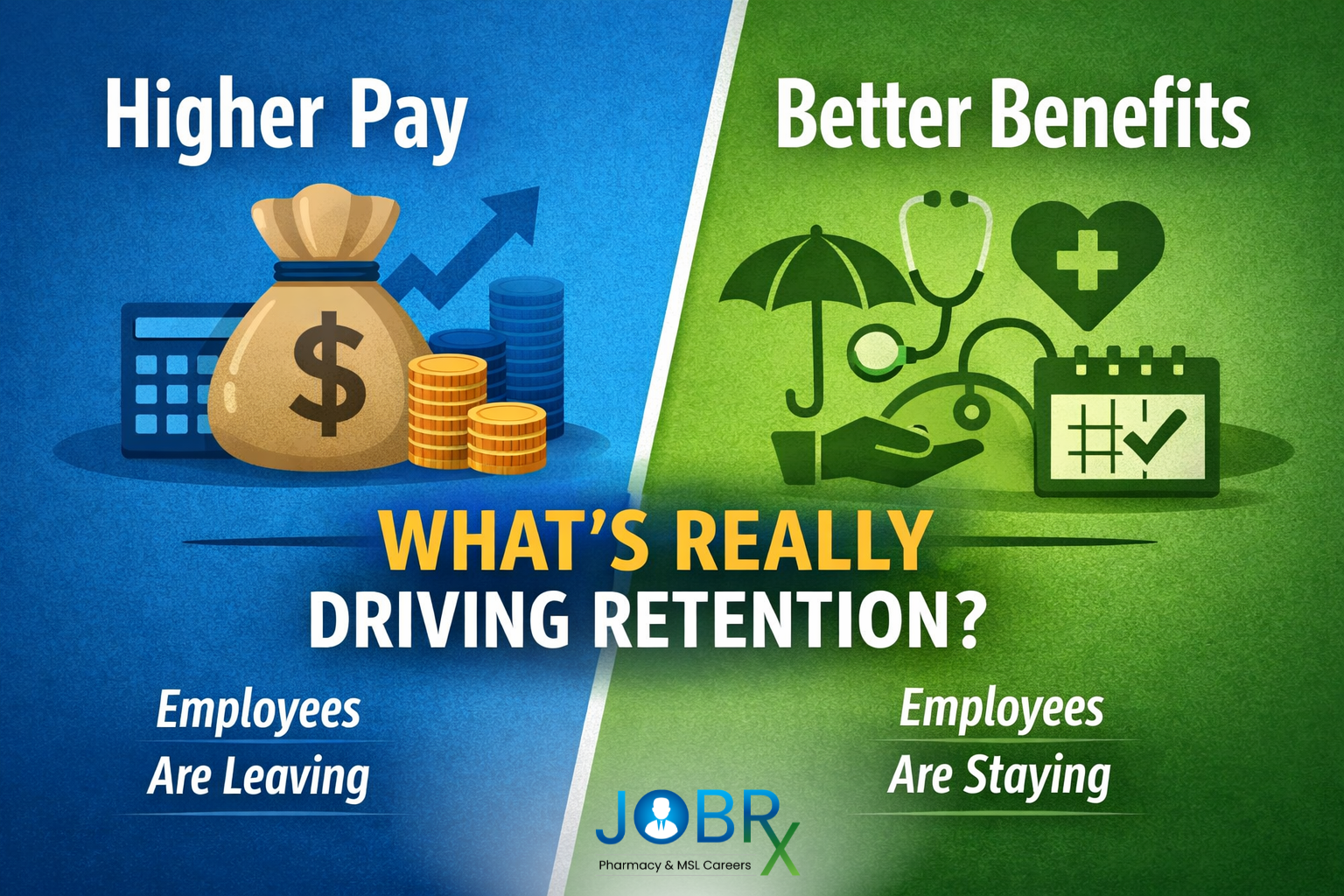
Why Higher Salaries Aren’t Solving Your Retention Problem
Employees Are Walking Away from Higher Pay.
Why HR Didn’t See It Coming — and Why Healthcare Leaders Can’t Afford to Miss It Again
For decades, compensation was considered the ultimate retention lever. Pay people more, and they stay. Pay them less, and they leave.
Except that equation no longer holds.
Across industries — and increasingly within healthcare and pharmaceuticals — employees are making quieter, more calculated trade-offs. They are choosing stability over salary. Flexibility over bonuses. Comprehensive benefits over incremental base pay increases.
And many organizations didn’t see it coming.
The Retention Blind Spot
Research confirms what HR leaders are now experiencing firsthand.
A recent study from Pew Research Center found that health insurance, retirement benefits, and paid leave rank among the most important factors employees consider when deciding whether to stay in a role — often rivaling compensation itself.
Similarly, data from Gallup shows that employees who feel their employer cares about their overall well-being are significantly more engaged and less likely to leave — regardless of pay level.
Compensation remains important. But it is no longer sufficient.
The blind spot for many organizations is visibility. Employees see their paycheck every two weeks. They do not see what their employer contributes toward medical premiums, mental health coverage, disability protection, caregiving support, or retirement matching.
Yet when life happens — illness, burnout, caregiving demands — those invisible investments suddenly become decisive.
Why This Matters More in Healthcare and Pharma
For Directors of Human Resources, Directors of Pharmacy, and Medical Affairs leaders, this shift is not theoretical.
Healthcare and pharmaceutical organizations are navigating:
- Clinical burnout and staffing shortages
- Regulatory pressure and performance intensity
- Rising healthcare costs
- Global talent competition for specialized scientific roles
In pharmacy operations alone, workforce strain has reached critical levels. The American Pharmacists Association has repeatedly highlighted staffing challenges and burnout risks affecting retention across practice settings.
In Medical Affairs, competition for MSLs, clinical strategists, and regulatory experts remains fierce. Base salary increases are common — but they are also quickly normalized in competitive markets. They do not create emotional loyalty.
Benefits do something different.
They signal institutional commitment.
In high-pressure environments like healthcare and pharma, employees increasingly evaluate employers through a new lens:
Will this organization support my life — not just my output?
That is a fundamentally different retention question.
The Psychological Contract Has Shifted
According to research published by Harvard Business Review, organizations that invest meaningfully in employee well-being generate higher trust in leadership and stronger long-term performance outcomes.
Benefits communicate expectations. Comprehensive medical coverage, flexible leave policies, mental health access, caregiver support — these do more than fill an enrollment brochure.
They communicate: We expect you to be human here.
In industries where burnout is measurable and documented, that message carries significant weight.
Employees are no longer optimizing for maximum salary. Many are optimizing for risk mitigation:
- What happens if I or my child gets sick?
- Can I take real time off without career damage?
- Will this employer support me through life transitions?
Compensation answers short-term questions. Benefits answer long-term ones.
And long-term security builds trust.
Why HR Didn’t See It Coming
Compensation strategies are visible, measurable, and competitive. Market benchmarks are clear. Salary bands are published. Offers are negotiated.
Benefits, by contrast, are often treated as administrative.
That is a strategic mistake.
According to analysis from McKinsey & Company, organizational initiatives most often fail not because of financial mechanics, but because of people and culture dynamics. In other words, investment alone is not enough — communication, operational discipline, and leadership alignment determine impact.
In many organizations, benefits programs are strong on paper but weak in storytelling.
Managers frequently cannot articulate total rewards value. Employees underestimate employer contributions. Utilization data goes unanalyzed. HR operations focus on compliance rather than strategic leverage.
The result: leaders assume compensation drives retention, because compensation is what they see discussed most often.
Meanwhile, employees quietly calculate differently.
The Healthcare-Specific Risk
This shift carries particular implications for healthcare and pharmaceutical leaders.
- Burnout amplifies benefit value.
In high-intensity environments, access to mental health services, flexible scheduling, and protected time off carries disproportionate weight. - Clinical talent evaluates risk exposure carefully.
Healthcare professionals understand medical cost realities better than most. Comprehensive coverage is not a perk — it is a strategic necessity. - Mission-driven employees expect alignment.
Organizations focused on improving patient outcomes must demonstrate equal commitment to employee well-being. Any disconnect erodes credibility. - Rising healthcare costs increase benefit salience.
As premiums and out-of-pocket expenses rise nationally, employer-sponsored coverage becomes a differentiator.
In competitive hiring markets for pharmacists, regulatory leaders, and medical science liaisons, salary competition quickly reaches parity. Benefits design — and flexibility architecture — becomes the sustainable advantage.
The Role of HR Operations
Even best-in-class benefits fail without operational rigor.
High-performing HR organizations treat benefits with the same discipline as compensation:
- Benchmarking plans against industry leaders
- Tracking utilization trends
- Analyzing retention correlations
- Training managers to articulate total rewards value
- Proactively communicating during life events
Managers are especially critical. If frontline leaders cannot explain how benefits support employees, value remains invisible until crisis.
And crisis is not an optimal retention strategy.
For healthcare systems and pharmaceutical companies operating in regulated, performance-driven environments, operational excellence in HR is not optional. It is reputational.
Compensation Gets Attention. Benefits Build Loyalty.
Compensation still matters. It always will.
But it primarily drives attraction.
Benefits drive retention.
The organizations winning in competitive labor markets are not necessarily the ones paying the most. They are the ones investing the smartest — designing benefit ecosystems that reduce life friction for employees navigating demanding careers.
For HR Directors, Pharmacy leaders, and Medical Affairs executives, the strategic question is no longer:
“Are we paying competitively?”
It is:
“Are we supporting our workforce in ways that meaningfully reduce risk, stress, and uncertainty?”
In an era defined by burnout, caregiving complexity, and rising healthcare costs, employees are making different calculations.
They are choosing predictability. Security. Flexibility.
They are choosing employers who demonstrate that performance and humanity can coexist.
Compensation may get employees in the door.
But in healthcare and pharma — where pressure is constant and talent is scarce — benefits are increasingly what make them stay.
And leaders who recognize that shift early will hold the competitive advantage.