

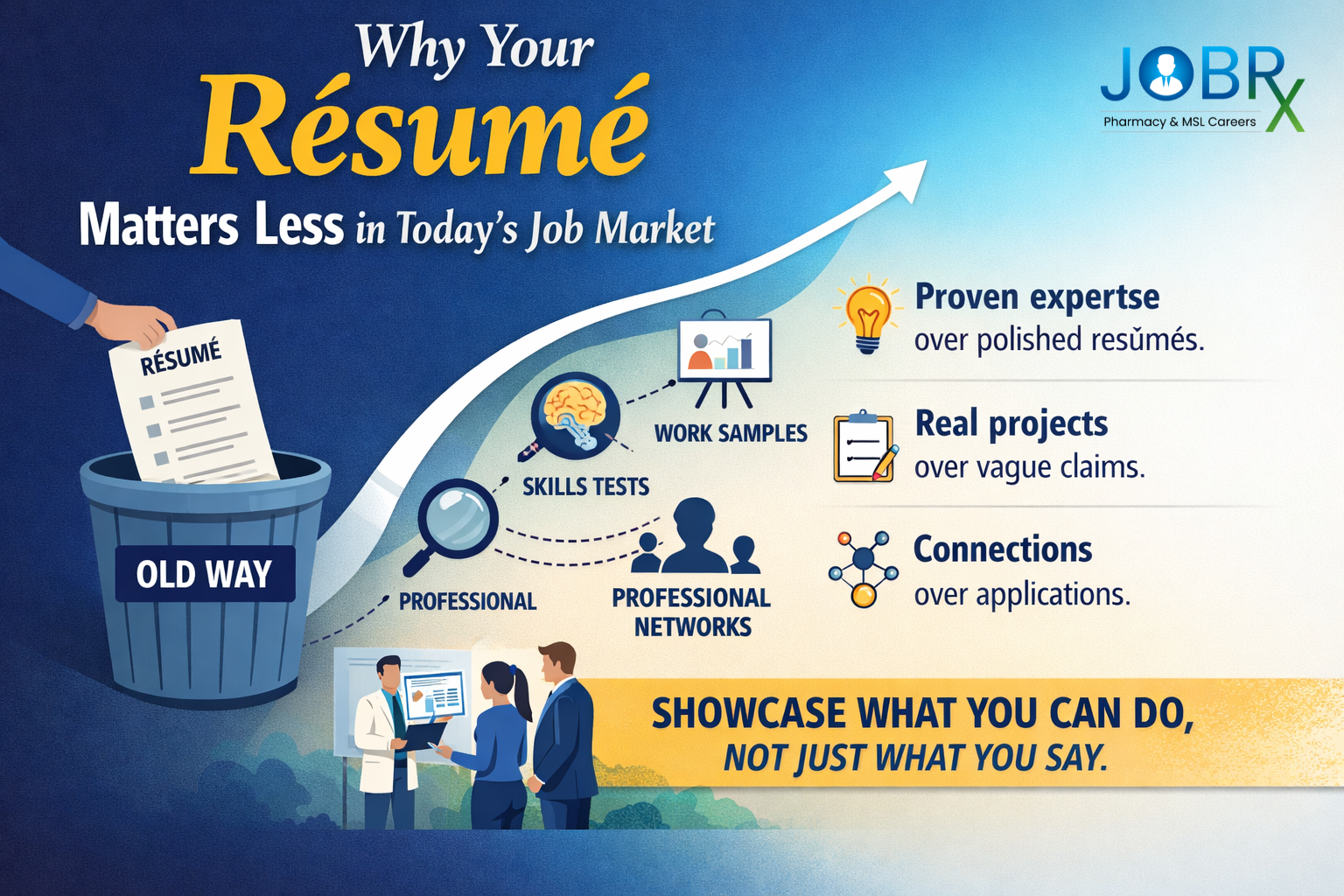
The résumé is losing its power in hiring
The Résumé Is Losing Its Power — What Healthcare Professionals Need to Know
For decades, career advice has centered on one idea: perfect your résumé.
But in today’s hiring market, something surprising is happening — many hiring managers say they barely read them anymore.
Quick Takeaways
• The traditional résumé is becoming less important in hiring decisions.
• Employers are prioritizing skills, projects, and demonstrated expertise.
• Many roles are filled through networking and recruiter outreach.
• Professionals who share insights publicly are easier for recruiters to discover.
Historically, the résumé has been the gatekeeper of career opportunities.
Use the right format.
Highlight prestigious employers.
Quantify accomplishments.
Tailor keywords for applicant tracking systems.
But something surprising is happening in hiring right now.
More employers are quietly admitting that they don’t rely heavily on résumés anymore.
Some companies have even gone as far as saying it outright. A job posting from software company Expensify openly tells candidates: “Resume not your thing? That’s great, we don’t really read them anyway.” Another from Automattic, the company behind WordPress.com, states that a résumé is not required and not expected.
Instead, these companies ask applicants to answer questions, demonstrate skills, or complete short work trials.
While these examples come from the tech industry, the underlying shift is spreading across many sectors — including healthcare and the pharmaceutical industry.
And it’s happening for a few important reasons.
Why the Résumé Is Losing Influence
Why this matters: When everyone can produce a polished résumé instantly, employers need new ways to identify real expertise.
The biggest driver of this shift is technology.
With generative AI tools now capable of producing polished résumés and cover letters in seconds, recruiters are seeing an explosion of applications that all look remarkably similar.
Perfect formatting.
Strong action verbs.
Impressive buzzwords.
Yet many hiring managers report that these applications often fail to reflect real capability.
As a result, recruiters are increasingly skeptical of résumé claims and are looking for more reliable signals of ability.
At the same time, application platforms have made it incredibly easy to apply for dozens or even hundreds of jobs in minutes. Recruiters often receive hundreds or thousands of applications for a single role, making it impossible to evaluate each résumé closely.
The result is what many job seekers call the “application black hole.”
Applications disappear into automated systems, and candidates rarely hear back.
To solve this problem, companies are experimenting with new ways to evaluate talent.
Some are adopting skills-based hiring, which prioritizes demonstrated ability over degrees, titles, or years of experience. According to the National Association of Colleges and Employers, about 70% of employers now use some form of skills-based hiring.
Others are asking candidates to demonstrate expertise through:
- project portfolios
- case studies
- work simulations
- short-term paid trial assignments
Instead of asking, “Where have you worked?” employers are increasingly asking, “What can you actually do?”
What This Means for Healthcare and Pharma Careers
Why this matters: As hiring shifts toward demonstrated expertise, pharmacists, pharmacy technicians, and aspiring MSLs may stand out more by showcasing scientific knowledge, communication skills, and real-world impact than by relying on credentials alone.
For pharmacists, pharmacy technicians, and aspiring Medical Science Liaisons, this shift could significantly change how careers progress.
Traditionally, advancement in healthcare has relied heavily on credentials, institutional prestige, and years of experience.
But pharmaceutical companies, biotech firms, and healthcare organizations are increasingly interested in demonstrable expertise and communication skills.
For example, in Medical Science Liaison roles, employers often look for professionals who can:
- translate complex clinical data into clear insights
- communicate effectively with physicians and researchers
- analyze scientific literature
- build trusted relationships with key opinion leaders
These capabilities are difficult to evaluate through a résumé alone.
As a result, hiring teams may increasingly rely on:
- presentation assessments
- case-based interviews
- publication reviews
- real-world examples of medical communication
In other words, the hiring process is slowly shifting from credentials on paper to evidence of impact.
The Rise of “Quiet Hiring”
Why this matters: Many healthcare and pharmaceutical roles are increasingly filled through recruiter outreach and professional networks rather than public job postings, making visibility and relationships more important than simply submitting applications.
Another trend affecting job seekers is something career experts call “quiet hiring.”
Instead of posting roles publicly and sorting through massive numbers of applications, companies are increasingly filling positions through:
- internal promotions
- recruiter outreach
- professional networks
- LinkedIn discovery
In this environment, many of the best opportunities never appear on job boards.
Recruiters search directly for candidates who demonstrate expertise in public professional spaces.
This is why professionals who share insights online — whether through LinkedIn posts, presentations, or professional discussions — often attract unexpected opportunities.
They are effectively making their expertise visible.
Three Practical Strategies for Job Seekers
Why this matters: Understanding how hiring is changing can help you focus your efforts on the actions most likely to increase your visibility, credibility, and opportunities in today’s competitive job market.
If hiring is evolving beyond the résumé, how should healthcare professionals adapt?
Here are three strategies that can significantly improve visibility and opportunity in the current job market.
1. Showcase Expertise, Not Just Experience
Your résumé describes what you have done.
But employers increasingly want to see how you think and solve problems.
Consider sharing insights publicly, such as:
- summaries of new clinical research
- commentary on emerging therapies
- reflections on patient care challenges
- insights from conferences or professional learning
For aspiring MSLs, this can demonstrate your ability to interpret and communicate scientific information — a core part of the role.
2. Build Evidence of Your Work
Instead of relying solely on bullet points, consider ways to demonstrate your capabilities more concretely.
Examples include:
- presentations you have delivered
- educational materials you created
- research summaries or literature reviews
- quality improvement projects
- training programs you developed
Even informal projects can demonstrate valuable expertise.
Remember: employers increasingly want proof of capability, not just claims of experience.
3. Increase Your Professional Visibility
In the era of quiet hiring, visibility matters.
Recruiters often identify candidates through professional platforms rather than applications.
Simple actions can increase discoverability:
- posting thoughtful insights on LinkedIn
- engaging in professional discussions
- connecting with industry professionals
- sharing lessons learned from clinical experience
You don’t need to post constantly. Even occasional contributions can help signal expertise and credibility.
A Changing Hiring Landscape
None of this means the résumé is disappearing entirely.
It still serves as a convenient summary of your background and experience.
But it is increasingly just one signal among many.
Employers are combining multiple indicators when evaluating candidates, including:
- demonstrated skills
- professional reputation
- project work
- communication ability
- network recommendations
In other words, hiring decisions are becoming more holistic.
For professionals who are willing to share expertise and demonstrate their capabilities, this shift may actually create new opportunities.
Those who rely solely on submitting applications, however, may find the process becoming more frustrating.
The Bottom Line
The rules of hiring are evolving.
Résumés are no longer the primary gatekeeper they once were.
Instead, employers are looking for evidence of expertise, communication skills, and real-world impact.
For pharmacists, pharmacy technicians, and MSL job seekers, the most powerful strategy may no longer be perfecting a résumé.
It may be making your expertise visible.
Have you noticed hiring processes changing in your field?
Reply and share your experience — I may include insights from readers in a future issue.