

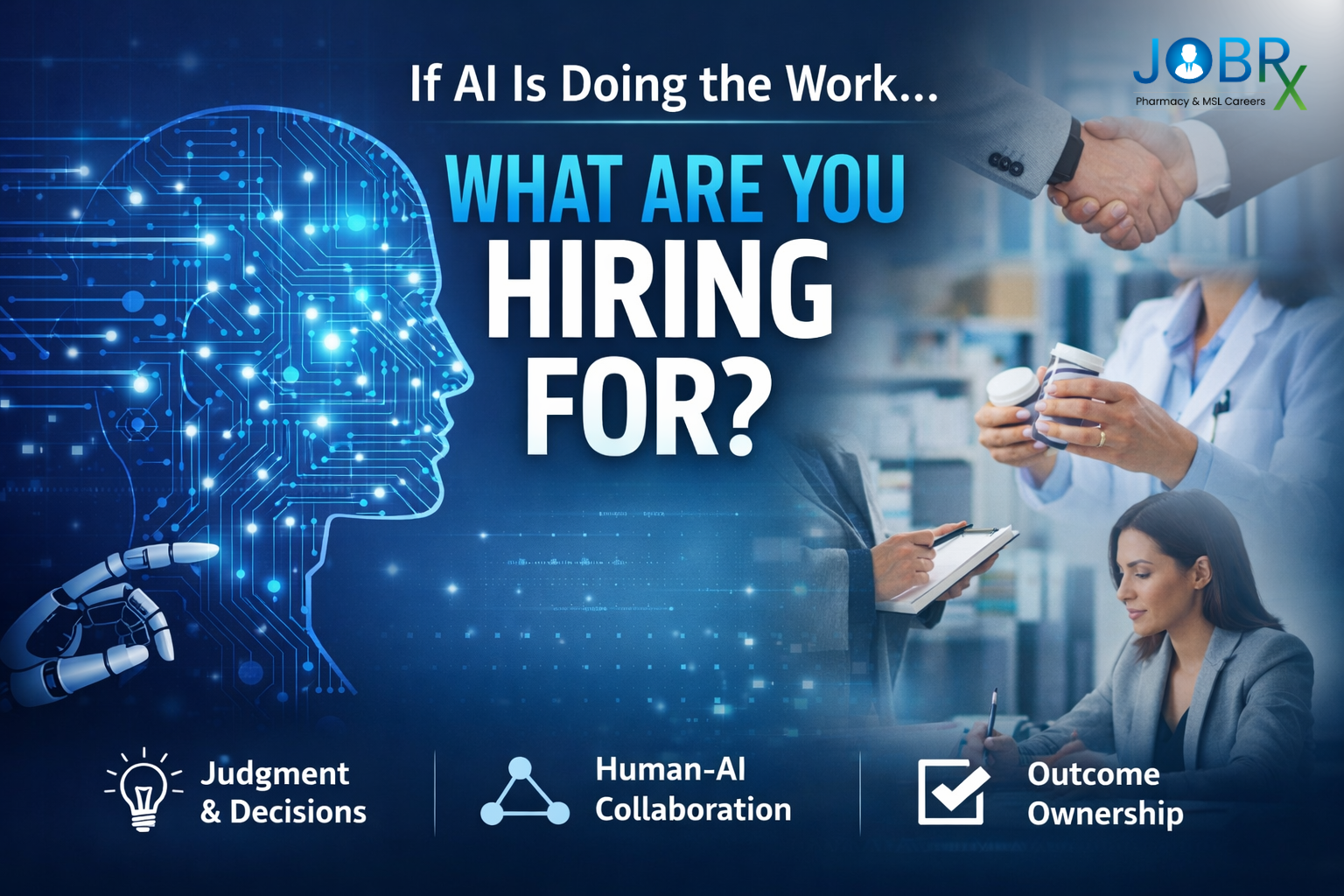
If AI Is Doing the Work… What Are You Hiring For?
That’s the question more HR, Pharmacy, and Medical Affairs leaders need to be asking right now.
Because AI isn’t just making work faster —
it’s quietly removing entire layers of tasks from many roles.
And yet, most organizations are still treating AI like a productivity tool.
According to McKinsey & Company, 78% of organizations are already using AI in at least one function. But many are simply layering it onto existing roles instead of redesigning the work itself.
That’s the gap.
The Shift Most Leaders Are Missing
Today, AI:
- Summarizes meetings
- Drafts communications
- Automates routine workflows
Helpful? Yes.
But the real transformation begins when AI moves from assisting → acting.
We’re already seeing this with companies like Klarna, where AI is handling a significant share of customer interactions — not just supporting employees, but doing the work itself.
In healthcare and pharma, the same shift is underway:
- Automated patient communications
- AI-driven medical information responses
- Intelligent workflow orchestration
When that happens, the role itself changes.
And most job descriptions don’t reflect that yet.
1. When Tasks Go Away, Judgment Becomes the Job
Many roles today are still built around tasks:
- Process requests
- Close tickets
- Complete documentation
But as AI absorbs repeatable work, what’s left are:
- Exceptions
- Tradeoffs
- Decisions without a script
For example:
A pharmacist may spend less time on dispensing logistics and more on patient counseling and
adherence strategy.
A Medical Affairs professional may handle fewer standard inquiries and more complex scientific engagement and insight generation.
An HR leader may spend less time on transactions and more on workforce design and capability building.
According to Deloitte, the organizations seeing the most value from AI are those that elevate human roles toward judgment, creativity, and relationships.
2. Stop Measuring Humans Like Machines
Here’s where many organizations get stuck:
They introduce AI… but keep the same KPIs.
If you’re still measuring:
- Speed
- Volume
- Throughput
You’re asking humans to compete with machines — on machine strengths.
That’s a losing strategy.
Instead, performance needs to shift toward what humans uniquely provide:
- Quality of decisions
- Patient or customer outcomes
- Ability to prevent future issues
- Strategic contribution
As Harvard Business Review has noted, AI-driven organizations must move from measuring efficiency → effectiveness.
3. AI Increases — Not Decreases — Accountability
There’s a common assumption that automation reduces responsibility.
In reality, it does the opposite.
When AI takes action:
- Who owns the outcome?
- Who reviews the decisions?
- Who steps in when something goes wrong?
In healthcare and pharma, where compliance and patient impact are critical, this isn’t optional.
Research from World Economic Forum highlights that governance and human oversight are among the biggest risks in AI adoption.
Leaders need to define:
- Clear ownership
- Escalation paths
- Ongoing review cycles
Because systems that “mostly work” are often the ones that fail quietly — until they don’t.
4. The Hiring Implication Most Leaders Haven’t Addressed
If AI is doing the tasks…
then the job is no longer the tasks.
But many organizations are still hiring for:
- Legacy responsibilities
- Outdated workflows
- Task-based job descriptions
This creates:
- Misaligned expectations
- Underutilized talent
- Confusion around performance
The shift is this:
 You are no longer hiring people just to do the work
You are hiring people to own decisions, guide systems, and improve outcomes
For HR, Pharmacy, and Medical Affairs leaders, that means prioritizing:
- Judgment under uncertainty
- Systems thinking
- Ability to work alongside AI
- Ownership mindset
Final Thought
AI isn’t just changing how work gets done.
It’s changing what the job is.
And if leaders don’t redesign roles intentionally, they will be redesigned anyway —
by technology, by inefficiencies, and by breakdowns in accountability.
The organizations that win won’t be the ones that adopt AI the fastest.