

Are you accidentally training your replacement at work?
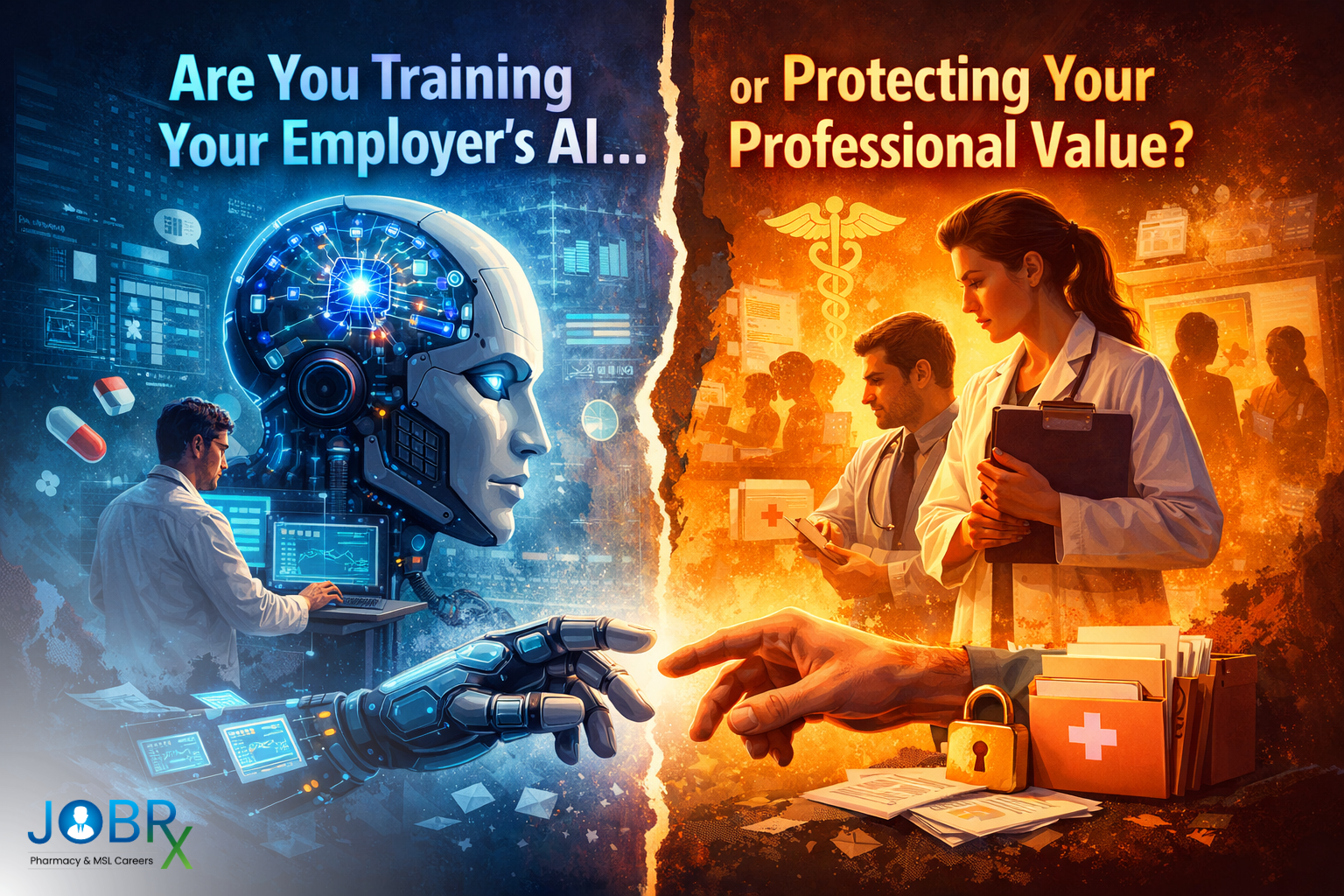
The Are You Training Your Employer’s AI… or Protecting Your Professional Value?
Every time you use AI at work, you might be doing two things:
- Solving a problem
- Quietly teaching your employer’s AI how you think
And in healthcare, that second part matters more than most people realize.
The Hidden Tradeoff No One Is Talking About
AI is quickly becoming part of everyday workflows for pharmacists, pharmacy technicians, and Medical Science Liaisons (MSLs). From summarizing clinical notes to drafting responses, it’s saving time and boosting efficiency.
But here’s the uncomfortable question:
Who owns the thinking behind what you create with AI?
When you use enterprise AI systems—those provided or monitored by your employer—you’re not just getting help. You may also be contributing to a system that learns from your inputs, your logic, and your decision-making patterns.
Over time, that system becomes smarter.
Not just smarter… but smarter in the way you are.
Why This Hits Different in Healthcare
In most industries, this is a productivity conversation.
In healthcare, it’s something more:
- Patient privacy (PHI)
- HIPAA compliance
- Clinical decision-making integrity
- Professional liability
Let’s make this real.
Pharmacists might use AI to:
- Sanity-check drug interactions
- Summarize patient cases
- Draft recommendations
Pharmacy Technicians might:
- Document workflows
- Generate SOP drafts
- Streamline inventory or insurance processes
MSLs might:
- Summarize clinical literature
- Draft scientific responses to HCPs
- Organize field insights
Now ask yourself:
Where is that information going? And who is learning from it?
Even when you think you’re sharing “safe” or “de-identified” information, context can still introduce risk. And beyond compliance…
There’s something bigger at stake.
The Intellectual Capital You Didn’t Know You Were Giving Away
Your value as a healthcare professional isn’t just what you know.
It’s how you think.
- How you evaluate a complex patient case
- How you prioritize treatment options
- How you communicate nuanced clinical information
That’s your professional edge.
When you rely heavily on enterprise AI—and especially when you input your reasoning—you may be externalizing that edge into systems you don’t control.
In other words:
You’re not just using AI. You may be training it.
And unlike your personal growth, that learning doesn’t stay with you.
A Quick Reality Check for Each Role
For Pharmacists:
Your clinical judgment is built on years of training and experience. If you routinely input case logic into AI tools, you may be codifying your decision-making patterns in ways that are no longer uniquely yours.
For Pharmacy Technicians:
Your workflow efficiency and operational knowledge are incredibly valuable. When you use AI to streamline processes, be mindful of how much internal structure and system knowledge you’re sharing.
For MSLs:
Your ability to translate complex data into meaningful insights is your differentiator. Feeding that thought process into AI—especially within enterprise systems—can blur the line between your expertise and organizational tooling.
The Compliance Trap: “Helpful” Doesn’t Always Mean Safe
One of the biggest risks in healthcare AI use is how easy it is to cross a line unintentionally.
You might think:
- “I didn’t include a name”
- “This is just a general case”
- “I’m just asking for help drafting something”
But depending on context, even partial information can become identifiable—or at minimum, sensitive.
And beyond data privacy, there’s another layer:
If AI contributes to a clinical or professional output… who is accountable?
You.
Not the tool.
Enterprise AI vs Personal AI: A Smarter Way to Think About It
This isn’t about avoiding AI. That’s not realistic—and frankly, not beneficial.
It’s about being intentional.
Here’s a simple framework:
Use Personal AI for:
- Thinking through problems
- Learning and skill-building
- Drafting ideas and frameworks
- Enhancing your capabilities
Use Enterprise AI for:
- Execution within approved workflows
- Non-sensitive operational tasks
- Organization-specific processes
The key difference?
Where the learning stays.
Personal AI helps you grow.
Enterprise AI may help the system grow—sometimes at your expense.
Practical Guardrails for Healthcare Professionals
If you’re using AI (and most of us are), here are a few principles to keep you on solid ground:
1. Never input identifiable patient information
This includes anything that could reasonably be traced back—even indirectly.
2. Be cautious with clinical reasoning details
Especially when tied to real or recent cases.
3. Treat AI outputs as drafts, not decisions
Your judgment is still the final authority.
4. Understand your organization’s AI policies
And assume more is being monitored or retained than you think.
5. Protect your thinking process
Your logic, structure, and approach are part of your professional value.
The Bigger Picture: Trust Is Your Currency
In healthcare, trust isn’t optional.
- Patients trust pharmacists with their safety
- Providers trust MSLs with accurate, unbiased information
- Systems trust technicians to keep operations running smoothly
AI can support that trust—or quietly erode it.
Not through one big mistake…
…but through small, repeated moments where convenience outweighs awareness.
Final Thought
AI isn’t going away. And used well, it can make you faster, sharper, and more effective.
But here’s the line worth remembering:
AI should amplify your expertise—not absorb it.
Because in a world where machines are learning quickly…
your ability to think independently, responsibly, and ethically is what will set you apart.
If this made you pause for a second, that’s a good thing.
Curious to hear how others in pharmacy and healthcare are thinking about this—
Are you using AI more on the personal side, enterprise side, or both?