

Is Your Hiring Process as Honest as You Expect Candidates to Be?
PHARMACEUTICAL LEADERSHIP SERIES | TALENT & WORKFORCE
The Trust Deficit in Pharma Hiring: When Both Sides of the Table Are Misleading Each Other
A new FlexJobs survey put the number at 1 in 3. But before Pharmacy and Medical Affairs leaders redirect their frustration toward candidates, the data has something to say about employers too.
The Numbers Are In — And They’re Uncomfortable for Everyone
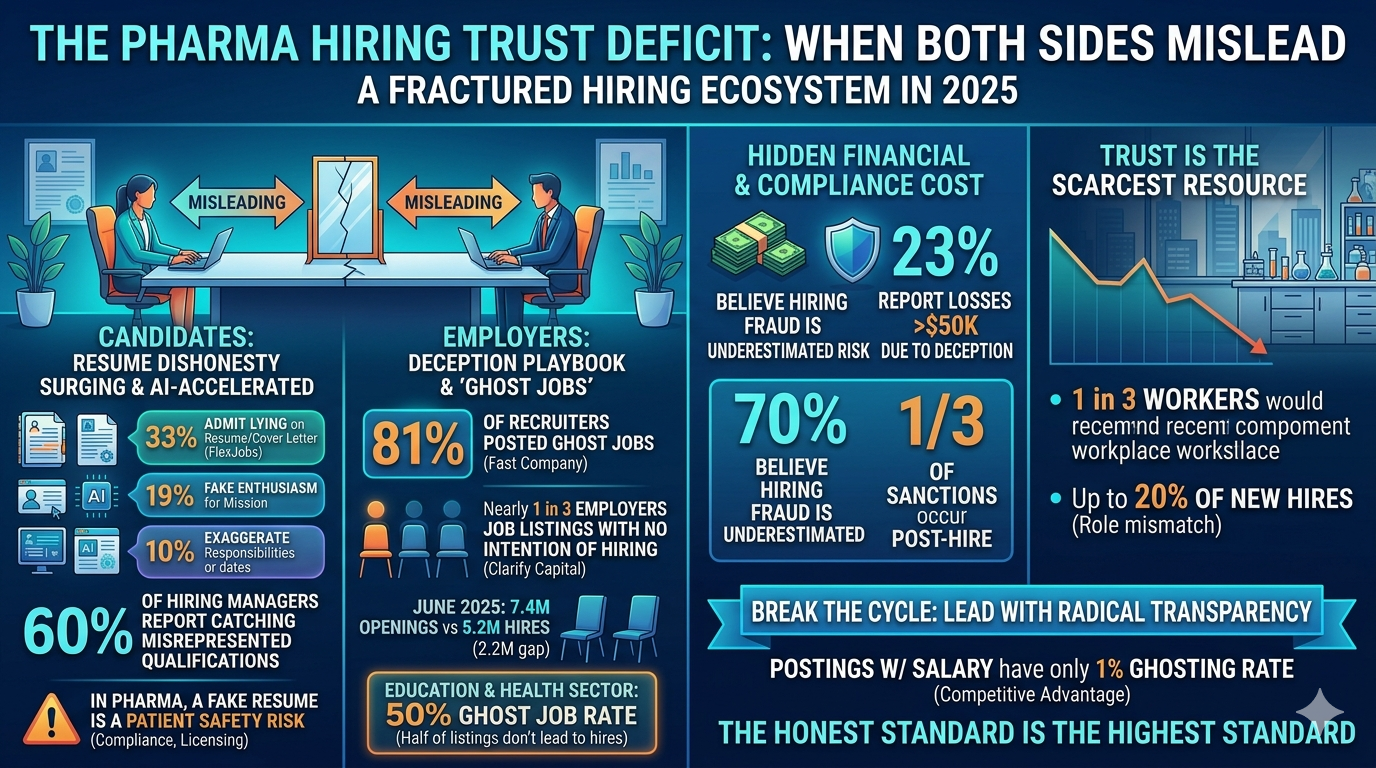
A new survey found that 33% of job candidates admit to lying on a resume or cover letter. That statistic has dominated HR conversations this month. But in pharmaceuticals — an industry built on evidence, accuracy, and compliance — the more important question is not just why candidates lie. It is what role hiring organizations play in creating the conditions that make dishonesty feel necessary.
The trust deficit in pharma hiring runs both ways. And leaders who are serious about building high-performing, compliant teams need to look clearly at both sides of the table.
Why This Matters Right Now
Pharmaceutical and healthcare hiring is under intense pressure. Talent pipelines are thinning, regulatory requirements around licensing and credentials are tightening, and competition for experienced Medical Affairs and Pharmacy professionals has never been fiercer.
In this environment, both candidates and employers are stretching the truth to get what they want. Candidates exaggerate qualifications to clear ATS filters and impress hiring panels. Employers oversell cultures, promise growth trajectories that don’t exist, and post roles they have no immediate intention of filling.
The result is a hiring relationship built on performance — and a workforce that is increasingly skeptical of the organizations recruiting them.
 Insight 1: Resume Dishonesty Is Surging — and AI Is Accelerating It
Beyond outright fabrication, 19% of job seekers admit to faking enthusiasm about a company’s mission, and 10% have exaggerated job responsibilities or extended employment dates to cover gaps. More critically for pharma: 60% of hiring managers say they have caught candidates misrepresenting their qualifications or backgrounds.
In a regulated industry where credential accuracy directly intersects with patient safety and OIG compliance, a falsified resume is not just an HR problem. It is a liability.
Insight 2: Employers Are Running Their Own Deception Playbook
Here is the data most HR newsletters will not publish: nearly 1 in 3 employers admit to posting job listings with no intention of hiring, and 81% of recruiters have posted ghost jobs — roles designed to build pipelines, signal growth, or benchmark talent, while real candidates invest time and hope chasing positions that will never be filled.
In June 2025 alone, employers reported 7.4 million job openings but made only 5.2 million actual hires — a gap of more than 2.2 million roles that never materialized. The education and health sector recorded a 50% ghost job rate.
The candidates who eventually lie on their resumes did not invent dishonesty. Many learned it from the hiring process itself.
Insight 3: The Financial and Compliance Cost Is Real
70% of hiring managers believe hiring fraud is an underestimated financial risk, and 23% report losses exceeding $50,000 in the past year due to hiring-related deception. In pharmaceutical organizations, those losses extend into compliance exposure. Approximately one-third of all OIG sanctions and exclusions occur post-hire — meaning initial screening alone cannot protect an organization.
Speed-to-hire pressure combined with dishonest recruitment practices creates a compounding risk that no background check can fully absorb.
Insight 4: Trust Is Now a Competitive Talent Advantage
1 in 3 workers would not recommend their current workplace, and ghost jobs and misleading job descriptions are direct contributors to that sentiment. Up to 20% of new hires quit within the first 45 days when the role did not match what was promised.
For Medical Affairs and Pharmacy leadership teams already operating lean, that revolving door is not just costly — it is operationally unsustainable. And the fix is simpler than most organizations acknowledge: job postings that include salary ranges have a candidate ghosting rate of just 1%. Transparency is not just ethical — it converts.
What This Means for Leaders Moving Into Executive Hiring Roles
For Pharmacy Directors and Medical Affairs leaders stepping into broader hiring responsibility, this moment is an inflection point. The organizations that will win the talent competition in 2025 and beyond are not the ones with the largest recruiting budgets. They are the ones with the most honest recruitment brands.
That means posting only roles with approved budgets. Giving candidates an accurate picture of team culture — including its challenges. Communicating clearly at every stage of the process, even when the answer is not yet or not you.
Building that reputation takes time. Losing it takes one bad hiring cycle.
The Honest Standard Is the Highest Standard
The pharmaceutical industry demands evidence-based precision in everything it produces. The same standard belongs in its hiring process.
When both sides of the recruitment table are managing impressions rather than sharing truth, the result is mismatched hires, early attrition, compliance exposure, and an employer brand that top candidates quietly avoid. The leaders who acknowledge that cycle — and commit to breaking it — are the ones who will build the high-integrity teams the next chapter of pharma requires.
What is one practice your organization could make more transparent in its hiring process?