

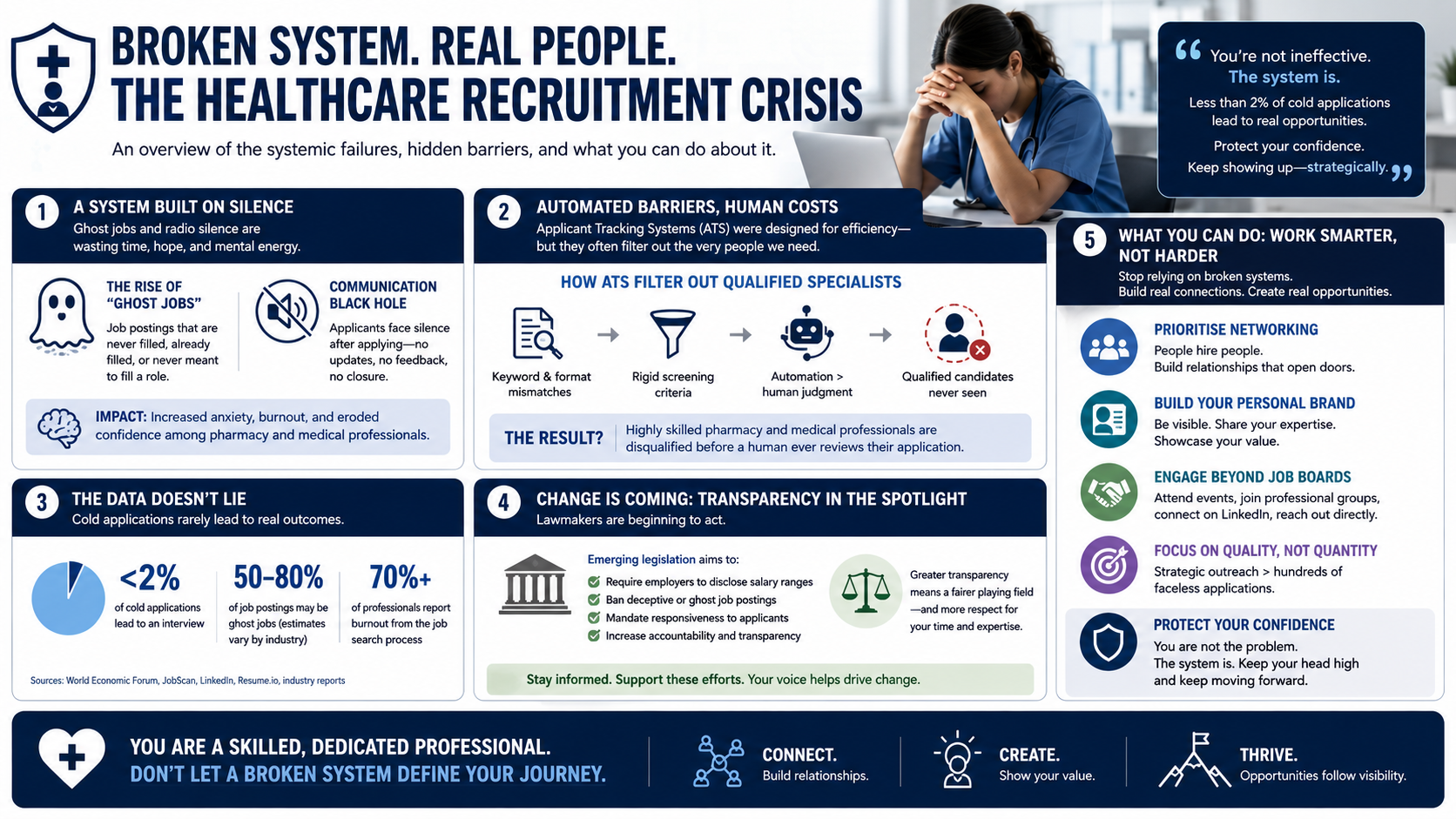
Is Your Dream Job Even Real?
Ghost jobs, ATS filters, and radio silence: what is actually happening to your applications.
You spent two hours tailoring your resume. You rewrote your cover letter three times. You hit submit and then nothing.
No confirmation. No rejection. Just silence.
If you are a pharmacist, pharmacy technician, or MSL candidate navigating today’s job market, this is not an anomaly. It is your Tuesday.
The healthcare hiring process is broken in specific, measurable ways. And it is time we named them.
Why This Is Happening Right Now
The gap between what job postings promise and what hiring teams actually deliver has never been wider.
Since the beginning of 2024, job openings have outnumbered actual hires by more than 2.2 million per month, according to Bureau of Labor Statistics data. That is not a talent shortage. That is a credibility problem.
For pharmacy and life sciences professionals, this hits differently. You are investing real time customizing applications for Clinical Pharmacist, MSL, and Medical Affairs positions roles that demand precision and preparation.
When that effort disappears into a system that was never designed to respond, it damages more than your schedule. A 2026 Resume Genius survey found 72% of job seekers report the search negatively affects their mental health, driven by long hiring cycles and poor communication.
Understanding where the system breaks gives you the power to navigate around it.
Ghost Jobs Are Not a Glitch. They Are a Pattern.
A MyPerfectResume survey found that 81% of recruiters admit their employer posts ghost jobs positions that may not exist, are already filled, or have no approved budget behind them.
For healthcare specifically, the numbers are striking. Analysis of June 2025 JOLTS data shows that education and health services had a ghost job rate of approximately 50%, meaning roughly half of posted positions in the sector never resulted in a hire.
For MSL candidates and pharmacists in specialized roles, this means a significant portion of the postings you are researching and applying to may never be filled.
Flag any role posted for more than 60 days with no visible updates. Cross-reference openings on the company’s own careers page before applying on aggregator sites. LinkedIn now tags more than half of its listings as verified filter for those first, and weight your energy toward networking where real conversations happen.
The ATS Is Not Your Enemy But It Is Not Your Friend Either
In 2025, 97.8% of Fortune 500 companies use an applicant tracking system, with Workday remaining the dominant platform, according to Jobscan’s annual ATS report.
The ATS does not automatically reject you. But it filters based on keyword alignment before a recruiter ever sees your name. 88% of employers acknowledge they are losing qualified candidates because resumes do not include the specific keywords the system is programmed to prioritize.
For pharmacy professionals applying to MSL roles, this is especially critical. If your resume says “patient counseling” but the job description says “disease state education,” the system may not connect those as the same competency.
Mirror the exact language of each job description in your resume. Use the specific terminology the posting uses for your clinical and scientific skills. Avoid tables, graphics, or columns most ATS platforms cannot parse them accurately.
Ghosting After the Interview Is the Real Damage
61% of job seekers report being ghosted after a job interview, a nine percentage point increase since April 2024, according to Greenhouse’s State of Job Hunting report.
For biopharma and life sciences professionals specifically, a BioSpace survey of over 900 respondents found that job ghosting and ghost jobs ranked as the top two frustrations with 35% citing employer ghosting and 34% citing fake listings as their number one complaint.
What makes this especially costly in healthcare hiring is the timeline. 61% of HR and talent acquisition professionals say it takes 30 to 60 days on average to fill a position, with 38% indicating time-to-hire is at least 46 days. When a company goes silent after a second-round interview at the 45-day mark, you have often already turned down other conversations to stay available.
Set a clear internal deadline: if there is no response within 10 business days of your last touchpoint, send one professional follow-up. After that, redirect your energy forward. Do not hold your entire pipeline hostage for one role.
Regulatory Pressure Is Building But It Is Not Here Yet
California introduced AB 1251 in early 2025, which would require employers to disclose in every posting whether the position is an actual vacancy. At the federal level, the proposed Truth in Job Advertising and Accountability Act would impose fines of at least $2,500 per violation for deceptive postings.
These are meaningful signals, but regulatory change is slow. The practical protection available to you today is knowledge: know what a ghost job looks like, how your resume is being read, and when to move on.
What This Means for Your Career Right Now
The traditional apply-and-wait model is no longer a standalone strategy. Research shows that only 0.1% to 2% of cold applications result in a job offer, and many candidates submit between 32 and over 200 applications before receiving an offer.
The professionals gaining traction are treating job searching as a relationship sport. They publish content on LinkedIn that demonstrates scientific credibility, attend Medical Affairs events, and reach out to hiring managers directly with specific, value-driven messages not generic asks.
Your expertise is real. The system is broken. Build your visibility so the right opportunities come to you, not just the ghost ones.
Before You Close This Email, Do One Thing
Audit every open application you have right now. Flag the ones older than 60 days. Prioritize your verified and network-sourced leads. And protect your time accordingly.
The healthcare hiring process has real, systemic problems and none of them are a reflection of what you bring to the table. Your clinical training, your patient-centered instincts, and your scientific fluency are exactly what Medical Affairs and pharmacy leadership teams need.
The right organization will recognize that. Keep going.