

The Hidden Cost of AI Confusion: What Healthcare and Biotech Leaders Must Fix Now
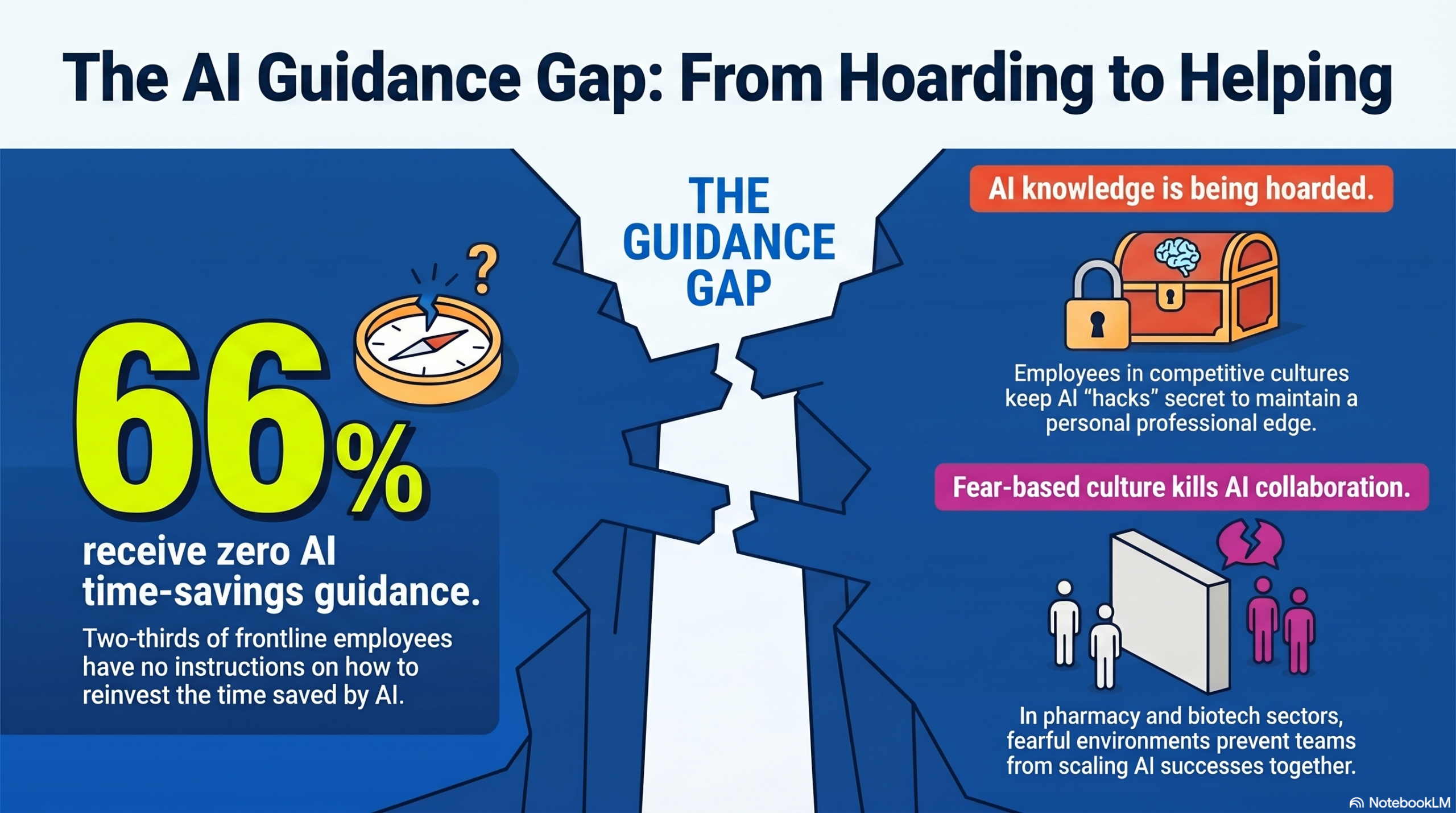
Your organization has likely invested in AI tools. Your team is probably using them. But the question worth sitting with: Does your team actually know why they are using them? A sweeping new study from Boston Consulting Group surveying nearly 12,000 frontline employees found that 66% received limited to no guidance on what to do with time saved by AI.
In healthcare and biotech, where every decision carries clinical, regulatory, or financial weight, that leadership silence is not a minor oversight. It is an expensive one.
AI adoption in healthcare is accelerating fast. According to a March 2026 survey by Fierce Healthcare, 75% of U.S. health systems are now using or planning to use an AI platform, and 50% are running three or more AI applications simultaneously.
Clinical note-taking, documentation improvement, and ambient listening are leading the charge, with some organizations reporting a 2x return on investment.
But adoption numbers only tell half the story. The other half is messier.
A Federal Reserve analysis published in April 2026 found a significant gap between how senior leaders and frontline workers perceive AI’s productivity potential, with leaders projecting stronger gains while workers report confusion, hesitation, and fear.
A Healthcare IT Today report from May 2026 put it plainly: 81% of healthcare leaders say their workforce is not yet equipped to effectively leverage AI in the workplace.
The tools are in the building. The strategy is not. And for Pharmacy Directors, Medical Affairs leaders, HR teams, and Talent Acquisition professionals managing complex, compliance-heavy environments, that gap has a real price tag.
Insights
1. The Leadership Communication Breakdown Is the Root Cause
BCG’s Global AI at Work 2026 report identified the central problem with striking clarity. David Martin, BCG’s Global Leader of People and Organization, told Fortune: senior leaders are struggling to articulate what the vision and strategy for AI actually is.
The downstream effects are predictable: employee fear rises, objectives blur, and adoption stalls.
This is not a technology problem. It is a change management problem wearing a technology costume. When leaders frame AI adoption around cost reduction rather than workforce empowerment, fear and inertia follow.
The World Economic Forum, in a May 2026 analysis with Accenture, confirmed that organizations grounding their AI messaging in purpose and growth, rather than efficiency and headcount, see meaningfully higher engagement and utilization.
For healthcare and biotech managers specifically, this means the briefing you give your pharmacy team, your MSL cohort, or your HR department about AI tools matters as much as the tools themselves.
2. “Tokenmaxxing” Has Run Its Course and Healthcare Cannot Afford to Repeat It
At large tech companies, the pressure to show AI usage metrics led to a phenomenon now being called “tokenmaxxing,” where employees maximized AI interactions to hit company-set targets, with little regard for actual productivity outcomes.
Amazon ultimately scrapped its internal AI tracking after employees used AI bots to complete meaningless tasks simply to score well on internal dashboards.
BCG’s Martin stated directly that tokenmaxxing has probably run its course and is now hitting companies’ cost base hard.
Healthcare and biotech leaders should treat this as a cautionary signal. Mandating AI use without defining what good use looks like produces the same dysfunction in a clinical or Medical Affairs context as it did in Big Tech.
Pharmacy Directors pushing teams to use AI documentation tools without clear protocols, or Medical Affairs leaders deploying AI for literature review without governance guardrails, risk spending budget on noise rather than outcomes.
3. Employee Fear Is Silently Killing Your ROI
BCG research found a troubling secondary effect of poor AI communication: employees who feel fearful about AI displacement become secretive about how they use it. Rather than sharing workflows and prompts with colleagues, they hoard them as a personal competitive advantage.
In a sector where cross-functional collaboration between pharmacy, clinical, regulatory, and Medical Affairs teams is essential, that knowledge hoarding can quietly dismantle the very efficiency gains AI was meant to deliver.
Wolters Kluwer’s 2026 healthcare AI trends report flagged the rise of “shadow AI” as a direct consequence of insufficient governance, where staff use unauthorized tools outside of sanctioned systems, creating compliance and patient safety risks that leadership often does not detect until something goes wrong.
The antidote, according to BCG, is comprehensive upskilling paired with a deliberate sharing culture. Workers who feel empowered are far more likely to collaborate, teach peers, and drive adoption organically.
4. Governance Is Not Optional in a Regulated Environment
Healthcare IT leaders surveyed by HealthTech Magazine in January 2026 flagged the governance gap as their most urgent concern:
AI deployed without clear governance introduces bias and safety risks that erode clinical trust.
For Pharmacy Directors overseeing automated dispensing workflows, or HR leaders using AI for candidate screening in a compliance-sensitive hiring environment, the regulatory exposure is not theoretical.
The Gallagher 2026 AI Adoption and Risk Benchmarking report identified compliance and data privacy as the top concerns among business leaders, followed closely by eroding employee trust and change fatigue.
In healthcare and biotech, where HIPAA, FDA guidance, and DEA regulations intersect with technology decisions daily, governance frameworks must be built before adoption scales, not after.
Career and Opportunity Angle
For professionals in Medical Affairs, pharmacy leadership, and healthcare talent acquisition, the current AI confusion in the market creates a genuine career differentiator. Leaders who can articulate a clear AI strategy, build governance frameworks, and translate technology capabilities into team-level outcomes are becoming rare and highly sought after.
In a hiring environment where medical affairs recruiters and pharmacy recruitment professionals are increasingly screening for digital fluency alongside clinical expertise, demonstrating that you can lead an AI transformation, not just participate in one, is a meaningful competitive edge.
Talent Acquisition directors who build AI literacy into onboarding and performance frameworks are also better positioned to attract candidates who expect modern, forward-thinking workplaces. This is a leadership skill set that will separate high-performing healthcare and biotech organizations from those still waiting for clarity.
The productivity potential of AI in healthcare and biotech is real. So is the cost of getting the communication strategy wrong. The leaders who will look back on 2026 as a turning point are not necessarily those who deployed the most tools. They are the ones who took the time to answer the most important question their teams had: What are we actually trying to accomplish with this?
If you are a Pharmacy Director, a Medical Affairs leader, an HR professional, or a Talent Acquisition director sitting with that question right now, you are exactly where you need to be. The next step is answering it out loud, clearly, and consistently. Your teams are waiting.