

The Underdog No More: How Biotech Startups Are Outplaying Big Pharma for Top Medical Affairs Talent
For decades, the career path in Medical Affairs followed a predictable logic: land at a large pharmaceutical company, build your credentials, and climb a well-defined ladder. Big Pharma meant stability, resources, and prestige. Biotech meant risk. That calculus is shifting fast. Across hiring data, compensation benchmarks, and talent migration patterns, one trend is becoming impossible to ignore: biotech startups are no longer playing catch-up. They are winning.
Context & Why It Matters
The Medical Affairs landscape in 2026 looks nothing like it did five years ago. Medical Affairs is now firmly positioned at the center of scientific value creation. Once viewed primarily as a support function, it is now a driver of evidence generation, stakeholder engagement, and patient-centered decision making.
That evolution has changed who is hiring, how fast they are moving, and what professionals actually want from their careers.
On the Big Pharma side, the largest pharmaceutical companies are midway through a significant restructuring cycle, with over 22,000 roles cut across the 17 largest firms in 2025. Meanwhile, biopharma layoffs rose 16% year over year, with major cuts at companies like Novo Nordisk, CSL, and Bayer. Job postings across life sciences dropped sharply while applications surged, making an already competitive market even more crowded at the top.
Biotech, by contrast, is playing offense. Venture-backed startups are scaling medical teams earlier, moving faster through hiring decisions, and offering career structures that Big Pharma simply cannot match. For Medical Affairs professionals at every level, understanding this shift is not optional. It is a career strategy.
Core Insights
1. Biotech Is Now Competitive on Compensation and the Data Proves It
The most common objection to pursuing a biotech opportunity used to be money. That argument no longer holds.
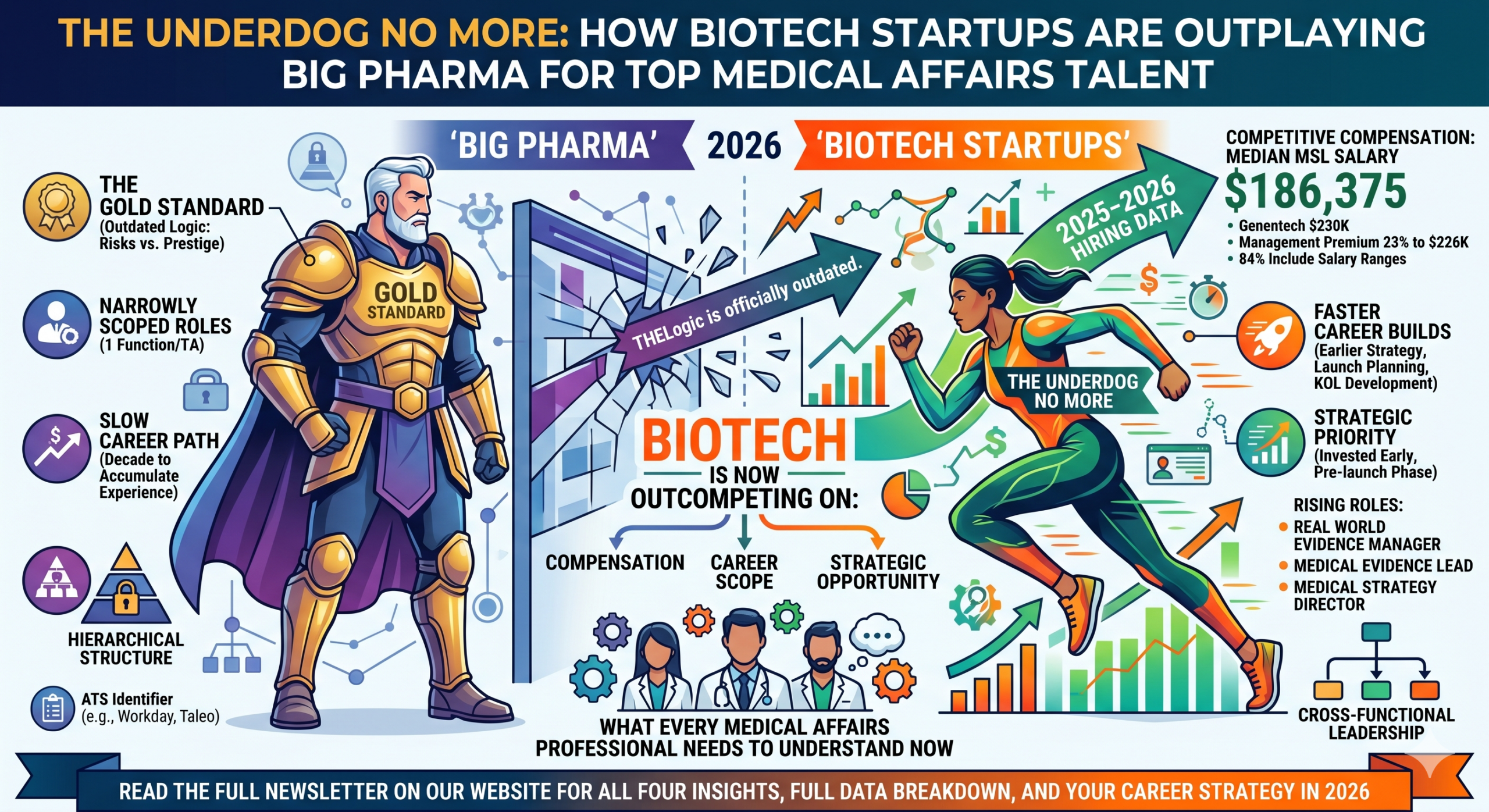
Analysis of 1,303 Medical Science Liaison job postings from November 2025 through May 2026 shows a median salary of $186,375, with 84% of postings including salary ranges. Critically, GSK leads among top payers at a median of $248K, followed by Genentech at $230K and AstraZeneca at $218K with Genentech, a Roche biotech subsidiary, standing as proof that biotech-affiliated organizations compete directly with the largest names in pharma. Management roles command a median of $226K compared to $184K for individual contributors, a 23% premium.
For Medical Affairs leaders evaluating their next move, compensation at biotech and hybrid biotech-pharma organizations is no longer a trade-off. It is a selling point.
2. Biotech Hires for Breadth and That Builds Stronger Careers Faster
Roles in Big Pharma are typically narrowly scoped. A professional at a company like AstraZeneca or Roche will usually own a specific submission type within a specific therapeutic area, supported by a large team with clearly delineated responsibilities. That depth is valuable. But it comes at a cost.
Biotech startups often recruit before product-market fit. They move quickly, value adaptability, and hire generalists with high learning velocity. For Medical Affairs professionals, this means earlier exposure to strategy, cross-functional leadership, launch planning, and KOL development experiences that would take a decade to accumulate inside a large pharmaceutical structure.
The trade-off is real. Biotech carries more risk, particularly at the pre-commercial stage. Biotech risk is more concentrated and binary, particularly at pre-commercial stage, where a single data readout or financing event can determine whether the organization continues. But for professionals willing to operate with that ambiguity, the career acceleration is significant.
3. Biotech Is Building Medical Affairs Teams Earlier and More Strategically
One of the most important structural shifts is when biotech companies are investing in Medical Affairs and the answer is earlier than ever.
Biotech organizations in particular are investing early in Medical Affairs to support launches and build long-term scientific credibility. Rather than waiting for approval to staff up, a new paradigm is emerging across the biotechnology field, reshaping how emerging companies approach the critical pre-launch phase of drug development. Fractional and flexible Medical Affairs models are giving startups access to VP-level strategic leadership, field medical capability, and scientific communications expertise simultaneously at budgets that would have been impossible under traditional staffing models.
This changes the opportunity landscape for Medical Affairs professionals. Roles that once existed only at late-stage or commercial companies are now available earlier in the development cycle, at organizations moving with urgency and purpose.
4. The Broader Hiring Rebound Favors Specialists and Medical Affairs Is at the Center
As pipelines advance and execution accelerates, demand for specialized talent will rise. By mid-year 2026, the market is likely to see parts of the market tilt back toward the candidate, particularly in the roles that determine whether science becomes medicine.
There is still targeted demand for roles in medical science liaisons, regulatory affairs, and clinical research, especially those with expertise in AI, gene and cell therapy, and advanced analytics. Medical Affairs professionals with real-world evidence experience, data literacy, and omnichannel engagement skills are particularly well-positioned. Roles such as Real World Evidence Manager, Medical Evidence Lead, and Medical Strategy Director are increasingly common in 2026, as professionals who can interpret clinical data and digital engagement metrics are seen as critical to informed scientific strategy.
Career & Opportunity Angle
Whether you are an MSL evaluating your next role, a Medical Affairs Director weighing a startup opportunity, or an HR leader trying to compete for talent in a tighter market, the message from the data is consistent: the old hierarchy is dissolving.
Medical Science Liaison jobs at biotech organizations now offer compensation, scope, and career velocity that rival or exceed what Big Pharma can offer at the same level. For professionals working with a medical affairs recruiter or exploring Medical Science Liaison jobs independently, it pays to look beyond the household names. The companies building the next generation of therapies in oncology, rare disease, and immunology are actively building Medical Affairs teams right now and they are moving fast.
Call to Action / Closing
The professionals who thrive in this market will be the ones who read the shift early and position themselves accordingly. Biotech is not the consolation prize anymore. For many Medical Affairs professionals, it is the best seat at the table. If you are ready to explore what that looks like for your career or if your organization needs to compete more effectively for this talent reach out. We work with Medical Affairs professionals and hiring teams every day, and we know where the opportunities are. The question is whether you are ready to look where others are not.