

The 10.25% AI pay gap and Hospital Pharmacy Jobs
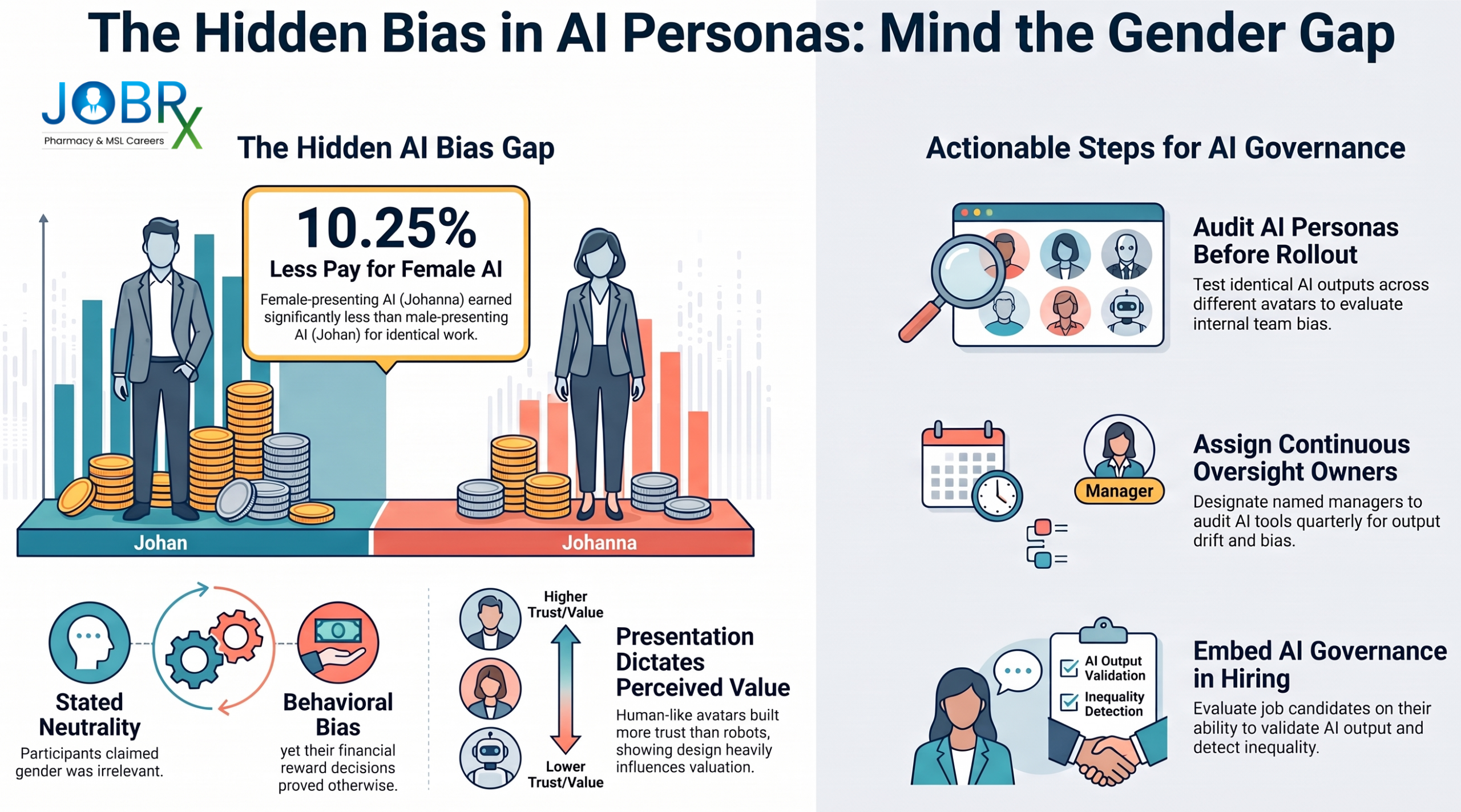
Two AI agents run on the same technology and complete the same work. One receives 10.25% less pay. The only difference is whether the agent presents as male or female.
University of Limerick researchers found this gap when 189 participants paid AI assistants in a virtual office, and the paper appeared at NordiCHI 2026.
If your team is adding AI agents, how you present them may shape how people value their work.
The study, Human-Like and Male?, placed 189 workers in a virtual reality office with four AI assistants: a text chatbot, a desk robot, and two human-like agents named Johan and Johanna. All four ran on the same underlying technology. After each task, participants paid the assistants with real money.
Human-like agents earned more trust and more credit than the desk robot. Between the two, Johanna received 10.25% less than Johan for the same work, and both women and men participants paid her less. Johan was also rated more human-like. Trust and credit did not differ significantly between the two.
Participants said gender did not matter to them. Their reward decisions suggested otherwise.
The timing matters. On April 20, 2026, the UK’s General Pharmaceutical Council published an AI position statement that expects pharmacy professionals to check AI outputs for bias and to stay accountable for their practice.
Pharmacy leaders in every market need a plan for the same question.
One caution. This was a controlled experiment about how people reward AI. It does not show how employers pay human staff, and it does not prove female-presenting AI will always be undervalued.
Core Insights
1. Stated neutrality does not predict behavior.
Participants said an assistant’s gender did not matter to them, yet their payments showed a gap. Many even said they preferred clearly non-human AI, yet they still rewarded the human-like agents more. HR leaders know this pattern: self-reported fairness is not a control.
When you pilot an AI agent, compare how staff rate and reward each persona, and audit outcomes rather than intentions. Repeat the check each quarter as tools change.
2. Presentation changes perceived value.
Johan was rated more human-like than Johanna, and human-like agents earned more trust and credit than the desk robot.
One participant explained the extra credit by saying it felt like a colleague sat next to them. Names, voices, and avatars are design decisions with human reactions attached.
Pharmacy Directors should record who chose each persona, why, and how it was tested, the same way they document any workflow change.
3. Medical Affairs has a confidence-to-action gap.
In the 2026 AI in Medical Affairs Industry Benchmark Survey, 86% of respondents expected AI to improve efficiency within two to three years, yet only 20% called their organization leading edge.
49% review every AI output by hand, and validation and accuracy led the barriers at 47%, followed by compliance and regulatory concerns at 43%. At a March 2026 MAPS Americas roundtable, leaders described AI use as mostly limited to menial tasks and cited the lack of clear FDA guidance as a barrier.
The survey drew 79 responses, and its authors say it is not statistically representative. Still, those manual review steps are exactly where bias checks belong.
4. Oversight cannot be set and forgotten.
A September 2026 Pharmacy Times article quotes Seth Hartman of UChicago Medicine, who warns about automation bias, inequitable performance, and deskilling.
He also cautions that accountability gets unclear when a deployed tool drifts. The article names performance monitoring as one of five infrastructure requirements.
One interviewee estimated that most organizations sit between 2.5 and 3.5 on a five-point AI maturity scale, an informal figure rather than survey data.
Assign a named owner to monitor each AI agent, including how it treats different users.
Hiring leaders face a positioning question as well.
In a global survey of 367 Medical Affairs professionals across 48 countries, published in Cureus in April 2026, 74% expected AI to be impactful or highly impactful for Medical Affairs and the MSL function. 87% said learning about AI is important or very important to stay competitive.
Candidates who can show how they validate AI output and flag bias will stand out for Medical Science Liaison Jobs, Pharmacist and Pharmacy Technician Jobs, and pharmacy leadership searches. Pharmacy Recruitment Services partners and in-house HR teams should add AI oversight to job descriptions, interview scorecards, and compensation discussions. Ask candidates how they would audit an AI agent for unequal treatment.
Before your next AI rollout, run one simple test. Give two agents identical performance and different personas, then check how your team rates and rewards them. Document what you find.
Then turn the lens on your own processes: would your evaluation and pay decisions pass the same test?
Tell us what your team is doing on AI governance. Reply to this email or share your approach with a colleague who leads a pharmacy or medical affairs team.