

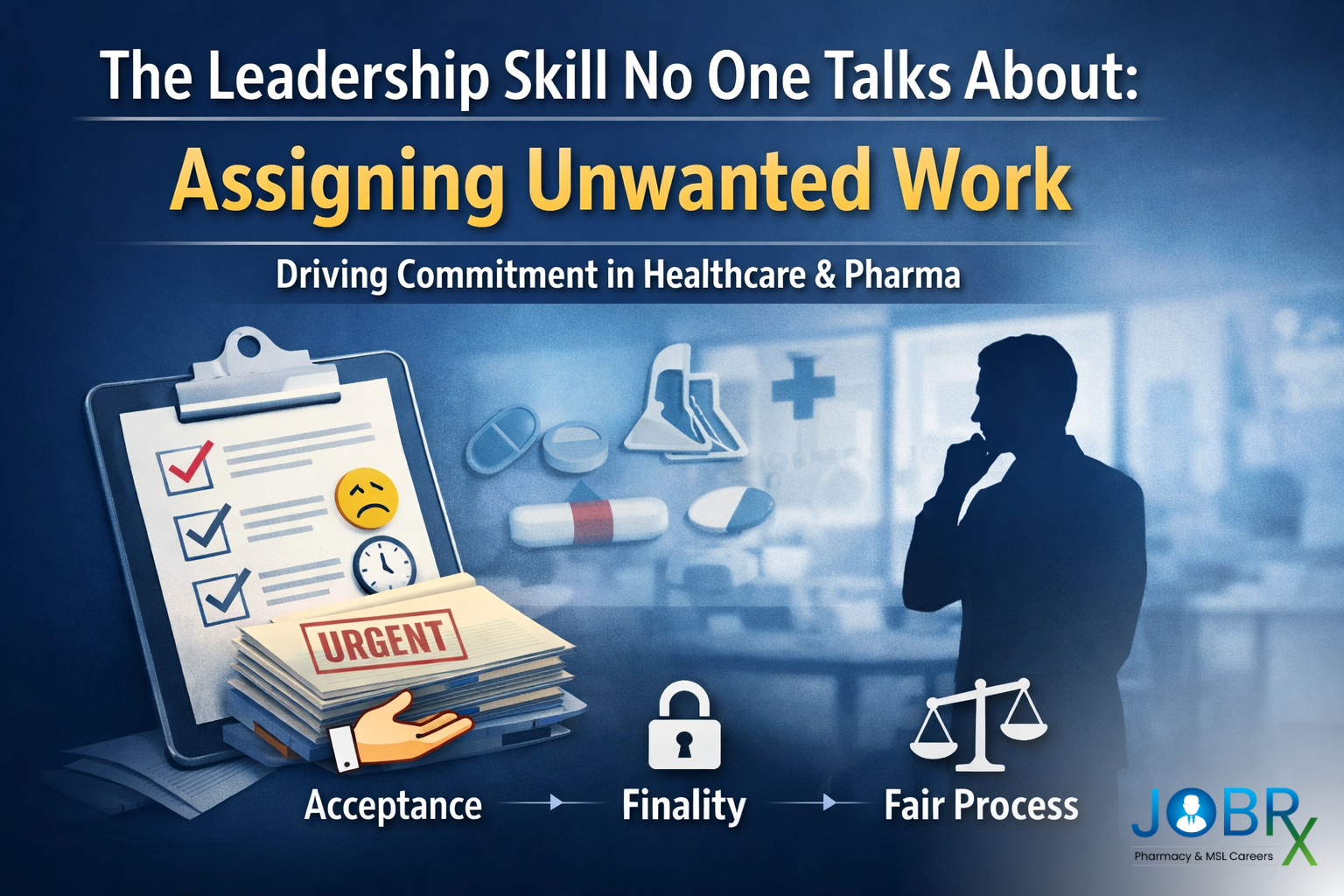
The Leadership Skill No One Talks About: Assigning Unwanted Work
When Leaders Must Assign Work No One Wants: Why “Acceptance” Matters More Than Buy-In
In healthcare and pharmaceutical organizations, not all assignments are inspiring.
Someone must take on the audit response. Someone must lead the remediation plan. Someone must inherit the difficult stakeholder. Someone must absorb additional responsibilities during a leave or restructuring.
For Directors of Human Resources, Pharmacy, and Medical Affairs, this reality is constant. Yet performance, engagement, and regulatory rigor still depend on commitment — even when the work wasn’t volunteered for.
The common instinct? Sell it. Incentivize it. Soften it. Or escalate authority.
But emerging behavioral research suggests a more powerful mechanism than persuasion: acceptance.
The Psychology Behind Acceptance
Research published in Psychological Review demonstrates that employees can rationalize and commit to outcomes they did not choose — provided they accept them as settled and legitimate (Eyal et al., 2024).
This finding builds on classic cognitive dissonance theory introduced by Leon Festinger in 1957, which shows that when behavior and attitudes conflict, people adjust their attitudes to restore internal consistency (Festinger, 1957). Traditionally, we’ve understood this to apply when individuals make voluntary choices.
The new insight: the same rationalization process can occur even when choices are assigned — if acceptance is present.
Acceptance does not mean liking the assignment. It means recognizing: “This is happening. This is what I will be doing.”
When acceptance is high:
-
Employees elevate the meaningful aspects of the work.
-
They downplay its unattractive features.
-
They commit more fully.
When acceptance is low:
-
They ruminate.
-
They resist.
-
They remain psychologically “half in, half out.”
In regulated industries like healthcare and pharma — where half-commitment can mean compliance risk, quality issues, or patient impact — this distinction matters.
Why This Is Especially Relevant in Healthcare and Pharma
Unlike many industries, pharmaceutical and healthcare environments often involve:
-
Regulatory deadlines that cannot move
-
High documentation burden
-
Risk mitigation work that is invisible but essential
-
Cross-functional friction (Medical, Commercial, Compliance, HR)
-
Staffing gaps during leaves or hiring freezes
In these contexts, “unwanted” work is not optional — it is structural.
At the same time, burnout across healthcare remains high. Research from the Mayo Clinic has shown persistent levels of professional burnout among physicians and pharmacists, often tied to workload and loss of autonomy (Shanafelt et al., 2019).
Layer on top of that is Gallup’s long-running employee engagement research, which consistently finds that perceptions of fairness and clarity from leadership strongly influence engagement (Gallup, State of the Global Workplace).
The implication for leaders is clear:
The way assignments are structured psychologically may matter as much as the assignment itself.
What Drives Acceptance?
The Psychological Review research identified three key drivers of acceptance:
1. Perceived Freedom (Even If Limited)
People are more accepting when they feel they have some control — even symbolic control — over the situation.
This aligns with decades of autonomy research, including self-determination theory, which shows that perceived autonomy fuels motivation and internalization (Deci & Ryan, 2000).
In practice, this does not mean the assignment must be negotiable.
Instead, leaders might ask:
-
Can the employee shape how the work is executed?
-
Can they influence sequencing or scope?
-
Can they propose support structures?
In a pharmacy operations context, the “what” (e.g., managing a formulary conversion) may be fixed. But giving discretion over the “how” can shift the psychological response from resistance to ownership.
2. Finality
Leaders often believe ambiguity softens bad news:
“Let’s try this for now.” “We’ll revisit in a few months.” “This may change.”
The research suggests the opposite.
When assignments feel provisional, employees struggle to accept them. They remain mentally undecided — which reduces rationalization and commitment.
In contrast, when outcomes are clearly settled, people adjust more quickly.
This insight echoes change management research from Harvard Business School professor John Kotter, who emphasizes the importance of clarity and decisiveness during transitions to reduce organizational drag (Kotter, 1996).
For Medical Affairs leaders navigating shifting portfolios or HR leaders restructuring teams, clarity may feel uncomfortable — but ambiguity may cost more.
3. Process Legitimacy
Perhaps most important: fairness of process.
Organizational justice research has long shown that employees are more accepting of unfavorable outcomes when they believe the process was fair and consistently applied (Colquitt et al., 2001).
The new research reinforces this finding. Even when participants received the same outcome, acceptance dropped when they felt autonomy had been revoked unfairly.
In pharmaceutical organizations — where compliance, governance, and transparency are core cultural pillars — this is especially relevant.
Leaders should ask:
-
Is the allocation logic clear?
-
Are criteria consistent?
-
Would I be comfortable explaining this decision publicly?
When the process feels legitimate, employees may not like the assignment — but they are far more likely to accept it.
Why Persuasion Can Backfire
Many leaders instinctively “oversell” unwanted assignments:
-
Emphasizing vague future opportunities
-
Over explaining strategic value
-
Offering incentives that feel compensatory
Ironically, these efforts can undermine acceptance.
Why?
Because they signal that the outcome is still negotiable — or worse, that leadership lacks confidence in the decision.
In healthcare and pharma, where credibility and decisiveness matter deeply, excessive persuasion may erode trust more than build enthusiasm.
Strategic Implications for HR and Pharma Leaders
For Directors of HR:
-
Structure assignment processes with transparent criteria.
-
Train managers to distinguish persuasion from clarity.
-
Audit whether ambiguity is unintentionally undermining commitment.
For Directors of Pharmacy:
-
When redistributing workload or assigning high-burden initiatives, clarify finality.
-
Offer discretion over execution methods.
-
Ensure staffing decisions are visibly fair.
For Medical Affairs Leaders:
-
Portfolio shifts and difficult stakeholder coverage are inevitable.
-
Anchor decisions in explicit capability alignment.
-
Avoid framing assignments as temporary if they are not.
Across all functions, acceptance is not about reducing standards or softening expectations. It is about aligning psychological reality with operational necessity.
The Leadership Shift
The traditional model of leadership assumes:
“If I can get them excited, they will perform.”
The research suggests a different equation:
If they accept it as settled, fair, and partly within their control — they will commit.
In complex, high-stakes environments like healthcare and pharmaceuticals, that distinction matters.
Leaders cannot guarantee that every assignment will inspire. They cannot eliminate regulatory burdens, staffing gaps, or difficult stakeholders.
But they can control how assignments are structured.
They can:
-
Build bounded autonomy into execution
-
Signal clear finality instead of lingering ambiguity
-
Ensure the process feels transparent and legitimate
And when they do, something powerful happens: Employees stop negotiating reality — and start owning it.
Before your next difficult assignment conversation, ask yourself:
-
Have I offered meaningful control over the “how”?
-
Have I made the decision clear and settled?
-
Would the allocation process stand up to scrutiny?
Because in the end, buy-in is not manufactured through persuasion.
It is built through acceptance.
And in healthcare and pharmaceutical leadership, acceptance may be the most underestimated performance lever we have.